

Two people sit in a cafe. One just opened a neighbourhood bakery. The other is building an app she hopes will change how millions order food.
Both are called “entrepreneurs.” Both work long hours and worry about money. But are they running the same kind of business?
Not at all.
One is running a traditional business. The other is building a startup. People often mix the terms up, and that confusion costs money, time, and peace of mind. It is also one reason most businesses fail at online marketing: they use the wrong plan for the wrong type of business.
What Is a Traditional Business?
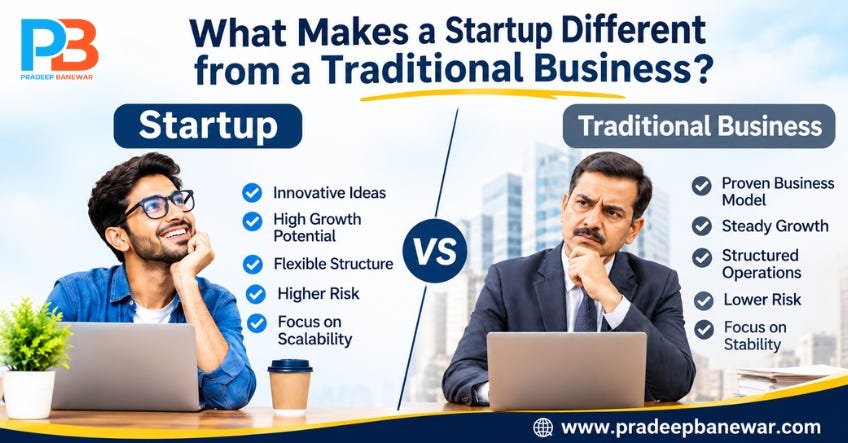
A traditional business sells a known product or service to a known market, using a proven model.
Think of:
A grocery store
A tailoring shop
A coaching center
A restaurant
A clinic or salon
The owner does not need to invent anything new. The idea already works. The goal is to run it well, earn steady profit, and grow slowly.
Key traits of a traditional business:
The business model is already tested.
Customers and competitors are easy to see
Profit starts early, often in the first year.
Growth is steady and tied to location, staff, and time.
A traditional business is like a well-marked highway. You know the route. You just need to drive carefully.
What Is a Startup?
A startup is a young company built to solve a problem in a new way, with the aim of growing very fast. A startup does not copy a known model. It searches for one. Until it finds a model that works and can scale, it is not a business yet. It is an experiment.
Key traits of a startup:
It tries a new idea, product, or technology.
It starts with big uncertainty.
It aims for rapid, large-scale growth.
It often spends money before earning any.
It may need investors to survive the early years.
A startup is like building the road while driving on it. Nobody has given you a map.
The 10 Biggest Differences Between a Startup and a Traditional Business
1. The Goal
Traditional business: Earn a steady income and build a stable company.
Startup: Grow as big as possible, as quickly as possible.
A bakery owner may be very happy with three profitable shops. A startup founder wants to reach a whole country, or even the world.
2. The Idea
Traditional business: Uses an idea that already works.
Startup: Tests an idea that may or may not work.
Opening a mobile repair shop is a proven idea. Building a platform that connects repair experts to customers through an app is a bet.
3. Risk
Every business has risk. The type of risk is different.
Traditional business: Risk is mostly about money, location, and competition.
Startup: Risk is about the idea itself. Will anyone want this? Will it work at all?
That is why startups fail more often. They are walking into the unknown.
4. Funding
Traditional business: Usually funded by personal savings, family, or a bank loan.
Startup: Often funded by angel investors, venture capital, or grants.
Investors do not give money for a small shop. They give money when they see a chance of a very large return. In exchange, founders give up part of their ownership.
5. Speed of Growth
Traditional business: Traditional businesses can speed up too, without any big investor money. Even a small shop can sell on WhatsApp without a website and reach more customers quickly.
Startup: Aims for “hockey stick” growth, a slow start followed by a sudden steep climb.
A tailor serves one customer at a time. A software startup can serve a million customers with almost the same team.
6. Scalability
Scalability means growing revenue without growing costs at the same rate.
Traditional business: Hard to scale. More customers usually means more staff, space, and stock.
Startup: Built to scale. A good app or online platform can add thousands of users at very little extra cost.
This is the single biggest reason investors love startups.
7. Profit Timeline
Traditional business: Aims to be profitable in the first year or two.
Startup: May run at a loss for years while it builds users and market share.
Whatever your timeline, pricing matters. Charging too little can slow down any business, as explained in the real cost of underpricing your services.
8. Innovation
Traditional business: Improves what already exists. Better service, better price, better location.
Startup: Creates something new or changes how things are done. Technology is often at the center. Today, tools like AI are reshaping entire industries, and startups are usually the first to use them. You can read more in this guide on how AI is reshaping every industry.
9. Team and Culture
Traditional business: Clear roles, clear hierarchy, set working hours.
Startup: Small team, many hats. One person may handle sales, design, and customer support in the same day. The culture is fast, flexible, and often chaotic.
Startup teams also often get equity (a share in the company) instead of only a salary.
10. The Exit Plan
Traditional business: The owner may run it for life, pass it to family, or sell it quietly.
Startup: Founders and investors plan an “exit.” This means the company is sold, merged with a bigger one, or listed on the stock market.
Myths About Startups
Myth 1: Every new business is a startup.
No. A new business is only a startup if it is built to scale fast with a new idea.
Myth 2: Startups always need investors.
Not always. Some are “bootstrapped,” which means they grow using their own money and early revenue.
Myth 3: Startups are only about technology.
Technology is common, but not required. A new way of delivering food, education, or healthcare can also be a startup.
Myth 4: Startups are always more successful.
Most startups fail. Many traditional businesses quietly build wealth for decades.
Why Most Startups Struggle (And So Do Many Traditional Businesses)
Whatever path you choose, some mistakes are common to both:
Building something nobody asked for
Running out of cash too early
Ignoring marketing until it is too late
Not listening to customers.
Trying to do too much at once
If marketing is your weak spot, fix it before you launch. Good digital marketing training teaches you how to find and keep customers, which is the problem that sinks many startups and small shops.
What Both Types of Business Need?
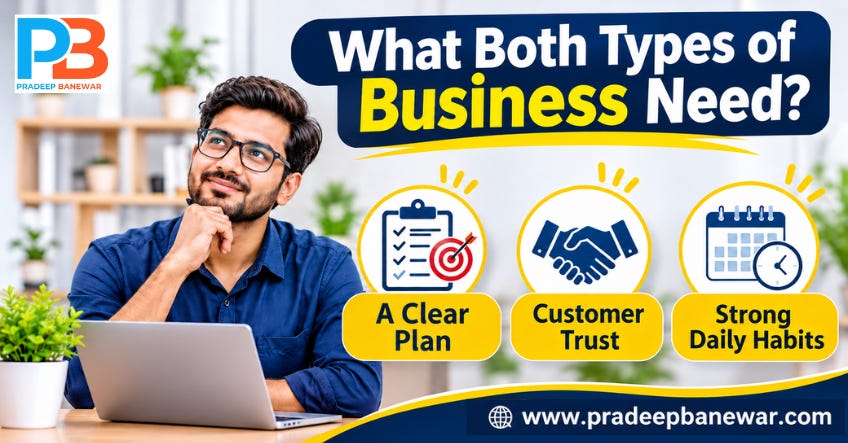
Despite their differences, startups and traditional businesses depend on the same foundations.
A Clear Plan
You do not need a 50-page document. A single page that answers “who do I sell to, what do I offer, and how will they find me?” is enough to begin. This simple one-page marketing plan for small businesses is a good starting point, and it works for startups too.
Customer Trust
Products can be copied. Prices can be matched. Trust cannot be copied easily.
Customers return to people they believe in. This is true for a village shop and a global app. Learn why customer trust is the new currency in business and how to earn it.
Strong Daily Habits
Running any business is a long game. The founders who last are not always the smartest. They are the most consistent. Their routines keep them focused when things get hard. Here are some daily habits of successful entrepreneurs and marketers worth copying.
Which One Should You Choose?
Ask yourself these simple questions.
Choose a traditional business if:
You want steady income and lower risk.
You prefer a proven idea.
You do not want to give up ownership.
You like building slowly and keeping control.
Choose a startup if:
You have a bold idea that solves a real, big problem.
You are comfortable with uncertainty.
You can handle years without a stable income.
You want to build something that reaches millions.
There is no “better” choice. The right choice depends on your goals, your money, your risk appetite, and your personality.
Can a Traditional Business Become a Startup?
Sometimes, yes.
A local business can add technology, build a new model, and aim for fast growth. For example, a neighbourhood grocery that builds its own delivery app and expands to many cities starts acting like a startup.
The reverse also happens. A startup that finds a stable model, becomes profitable, and slows its growth starts to look like a traditional business. Both are normal stages of a company’s life.
Simple Steps to Get Started
Whichever path you pick, these steps help.
Find a real problem: Talk to ten people who face it.
Test before you build: Sell a small version first.
Start small: Do not spend big money on day one.
Track your numbers: Know your costs, sales, and profit.
Learn marketing early: A good product with no visibility will not survive. If your budget is tight, start with this zero-cost digital marketing strategy for small businesses.
Stay flexible. Be ready to change your plan based on what customers tell you.