

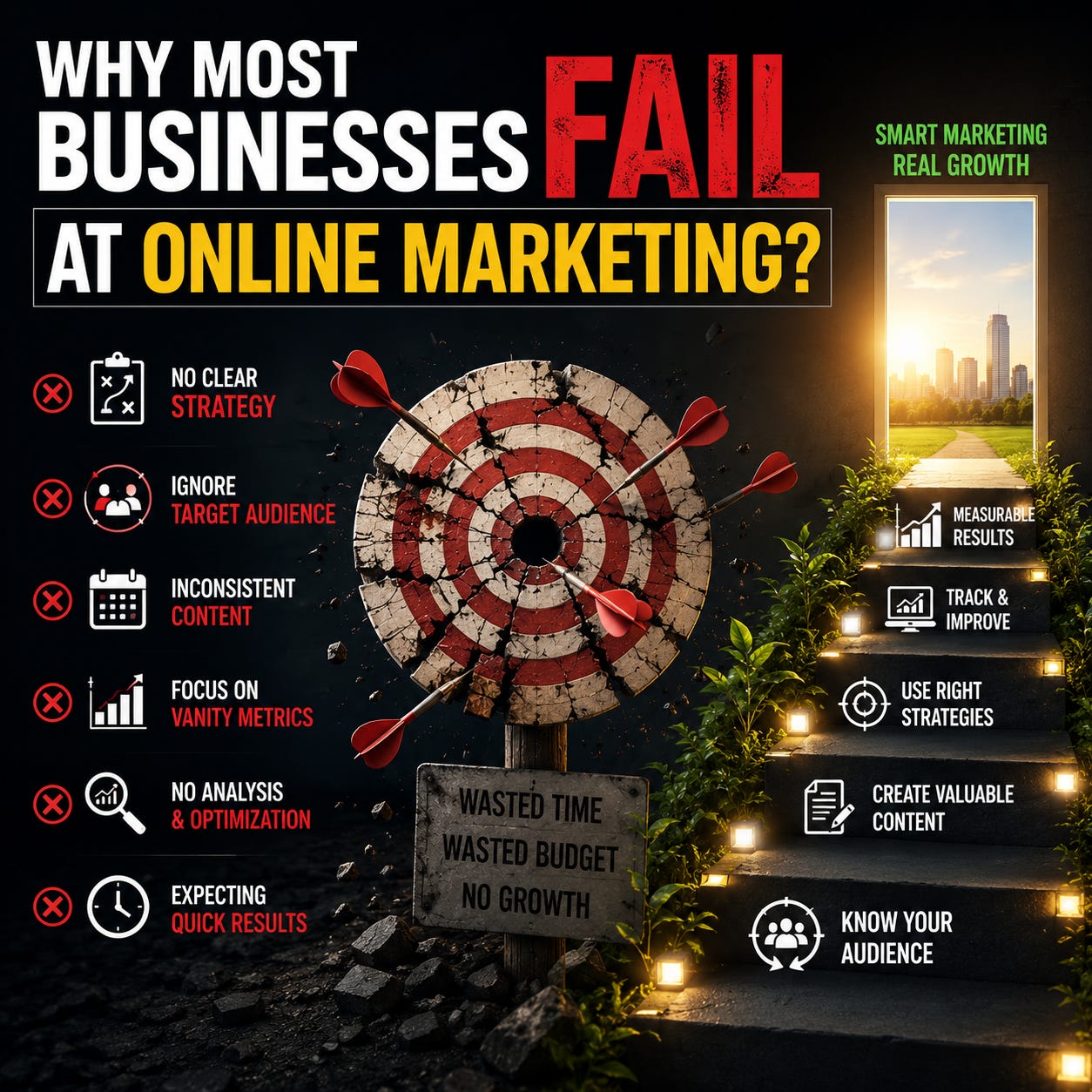
They built a website. They made an Instagram page. They even ran some Google Ads.
And then nothing happened.
No leads. No sales. No growth. Just money spent and time wasted.
This story is repeated thousands of times daily by businesses trying to grow in an increasingly competitive market. The business owner blames the platform. Or the agency. Or “the algorithm.” But the real problem is almost never any of those things.
The real problem is deeper. And more fixable than most people think.
When online marketing doesn’t deliver results, it’s usually because the strategy is flawed - not the channel.
Here is exactly why, and more importantly, what to do about it.
The Harsh Truth Nobody Tells You
Most businesses treat online marketing like a switch.
Flip it on, wait for customers to come. When they do not show up fast enough, flip it off and call it a failure.
But online marketing is not a switch. It is a system. And like any system, it needs the right structure to generate consistent results.
The businesses that succeed online are not always the ones with the largest budgets or biggest audiences. They are the ones who understand their customer, show up consistently, and give people a genuine reason to trust them.
Everything else is just noise.
Mistake 1: No Clear Strategy, Just Random Activity
This is the biggest reason most businesses struggle with online marketing.
They post on Instagram because their competitors do, and they run Google Ads because someone told them they should. They started a YouTube channel because they heard it works. None of it is connected. None of it has a clear goal.
Random activity feels like progress. It is not.
A real marketing strategy answers three questions before anything else:
Who is your ideal customer, and what specific problem are they trying to solve?
What outcome are you aiming for, and when do you want your customers to act?
Which channel reaches them most effectively at the lowest cost?
Without answers to these three questions, every post, every ad, and every rupee spent is essentially a guess.
If you are not sure where to even begin, a zero budget digital marketing strategy for small businesses gives you a clear framework to build from, without needing a big team or a big budget.
Mistake 2: Focusing on Their Brand Instead of Customer Needs
Open the Instagram page or website of almost any struggling business, and you will notice the same pattern.
Every post is about the product. Every caption is about the company. Every ad shouts “Buy Now” at people who have never heard of them before.
Nobody cares about your product. They care about their problem.
The businesses that connect with customers online lead with empathy, not promotion. They talk about the pain their customer is feeling. They answer the questions their customers are already asking. They make the customer the hero of the story, not themselves.
This shift in perspective is small, but the impact is enormous.
Instead of “We offer the best digital marketing services in Indore,” try “Struggling to get clients online? Here is what is actually working in 2025.”
One of those makes you scroll past. The other makes you stop and read.
To create high-converting content, you must first understand how customers move from discovering a problem to making a buying decision.
Mistake 3: Chasing Every Platform at Once
A new business owner gets excited. They want to be on Instagram, Facebook, YouTube, LinkedIn, Twitter, and a podcast, all at the same time.
Six weeks later, they are burnt out, their content is average on every platform, and they have real traction on none of them.
More platforms do not mean more reach. They mean more distraction.
The smartest move is to pick one or two platforms where your specific audience actually spends time, and go deep. Post consistently. Engage genuinely. Learn what works for that platform before even thinking about the next one.
One strong presence on the right platform will always beat a weak presence everywhere.
And the platform you choose matters a lot. Instagram Reels and YouTube Shorts are playing very different games, and understanding which one suits your content style and audience can save you months of wasted effort.
Mistake 4: Ignoring the Power of Trust
Here is something most businesses completely overlook.
People do not buy from businesses they have just discovered. They buy from businesses they have seen multiple times, found consistently helpful, and have started to trust.
The average customer needs anywhere between 7 and 12 touchpoints before they make a buying decision. Most businesses give up after two or three and assume the customer is not interested.
They are interested. They just are not ready yet.
Building trust online means:
Showing up consistently with content that genuinely helps
Sharing real results, real testimonials, and real stories
Being transparent about what you do and how you do it
Engaging with comments and messages like a real human being
Customer trust is the new currency in business, and once you understand that, your entire approach to content, messaging, and community changes completely.
Mistake 5: Running Ads Before the Basics Are Ready
This one is painful to watch.
A business spends twenty thousand rupees on Facebook or Google Ads. The ads get clicks. But nothing converts. So they blame the ads.
The problem was never the ads. The problem was what came after the click.
A slow website. A confusing landing page. No clear offer. No trust signals. No reason to buy now rather than later.
Paid ads are an accelerator. They take whatever you already have and amplify it. If what you have is broken, ads will just show that brokenness to more people, faster, and at a higher cost.
Before investing in paid advertising, make sure:
Your website loads in under 3 seconds.
Your offer is clear and specific.
There is a strong reason to act now, a deadline, a bonus, a limited offer.
There are testimonials, reviews, or proof that you deliver results.
There is a follow-up system to capture leads who are not ready to buy immediately.
Still figuring out whether to invest in SEO, social media, or Google Ads first? That decision depends on your business stage, your budget, and your timeline, and getting it right makes a massive difference.
Mistake 6: Creating Content Without a Content Strategy
Posting randomly is not a content strategy. It is busywork.
A real content strategy means knowing:
What topics does your audience search for and care about
What format works best on your chosen platform
How often you will post and what the goal of each post is
How your content moves someone from discovering you to trusting you to buying from you
Most businesses skip all of this and just post whatever feels relevant that day. The result is an inconsistent feed that confuses new visitors and fails to build any real momentum.
Content works like compound interest. It builds slowly but accelerates over time. A blog post written today can bring you leads for the next three years. A YouTube video published this month can earn views and subscribers long after you have forgotten you made it.
Social media and video have become the new search engines, which means your content is not just for your existing followers. It is being discovered every day by new people actively looking for what you offer. That changes how you should think about every single piece of content you create.
Mistake 7: Not Using Data to Make Decisions
Most business owners running online marketing have no idea what their numbers are.
They do not know which post brought the most profile visits. They do not know which ad had the lowest cost per lead. They do not know which page on their website is losing the most visitors.
Without data, you are flying blind.
The good news is that most platforms give you this data for free. Instagram Insights, Google Analytics, Meta Ads Manager, and LinkedIn Analytics all show you exactly what is working and what is not.
Start tracking these basic numbers every week:
Which content gets the most reach, saves, and shares
Where your website traffic is coming from
Which channel is generating actual leads or enquiries
Your cost per lead if you are running paid ads
Data gives you clarity. Instead of guessing what might work, you know exactly where to spend your time and budget.
Mistake 8: Giving Up Too Soon
This is the quietest killer of online marketing success.
Growth takes time, but many businesses quit before they reach the turning point.
They post for two months, see modest results, and decide online marketing does not work for their industry. They run ads for two weeks, do not get immediate sales, and pull the budget. They publish five blogs, rank for nothing yet, and abandon the strategy.
Online marketing has a compounding curve. The first three months feel slow. Months four to six feel slightly better. By month nine or twelve, if you have been consistent and strategic, results start to compound in ways that feel almost unfair.
The businesses succeeding online today are not smarter or luckier. They are the ones who stayed consistent when results were still small.
The daily habits of successful entrepreneurs and marketers all point to one common thread. They continue doing the work when progress seems slow, understanding that consistency is the real strategy.
So What Does Actually Work?
Here is the simple framework that separates businesses that grow online from those that struggle:
Know your customer deeply before you create a single piece of content.
Choose one or two key platforms and build meaningful engagement instead of dividing your attention across many channels.
Lead with value in every post, every email, and every ad.
Build trust before you ask for the sale.
Fix your foundations before spending on ads.
Track your numbers weekly and make decisions based on data.
Stay consistent for at least six to twelve months before judging results.
None of this is complicated. But all of it requires discipline, patience, and a willingness to keep learning.
Most businesses do not fail at online marketing because the internet does not work for them.
They fail because they show up without a strategy, talk about themselves too much, chase every platform at once, expect overnight results, and quit before the compounding begins.
The fix is not a bigger budget or a fancier agency.
The fix is clarity. Consistency. And genuine value delivered to real people over a long enough period of time.
Online marketing works. It just works on its own timeline, not yours.
Start with strategy. Stay consistent. Trust the process long enough to see it through.