

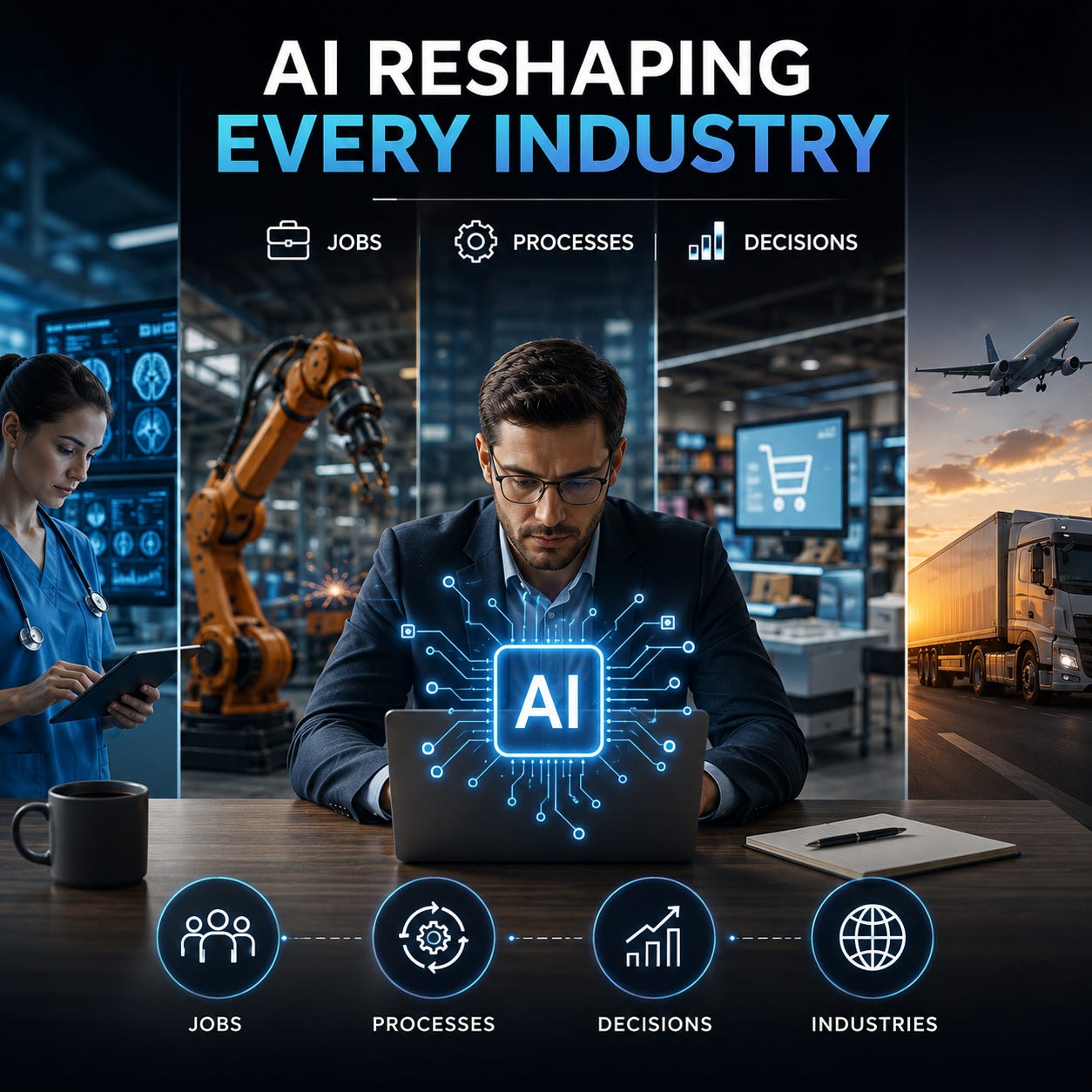
A doctor in Mumbai uses AI to detect cancer earlier than any human eye could.
A farmer in Punjab uses AI to predict the right time to irrigate his crops.
A teacher in Chennai uses AI to personalise lessons for every student in her classroom.
This is not the future. This is happening right now, in 2026, across every industry you can think of.
AI is now a practical tool for everyday businesses, not just industry leaders. It has entered hospitals, factories, schools, banks, farms, courtrooms, and living rooms. It is changing not just what work looks like, but who does it, how decisions get made, and what skills actually matter.
The debate isn’t about AI affecting your industry; it’s about how you will respond to it.
The real question is whether you’ll be prepared when that change arrives.
The Shift That Changes Everything
For most of human history, doing more required hiring more people.
Want to serve more customers? Hire more staff. Want to process more data? Build a bigger team. Want to make faster decisions? Add more managers.
AI has broken that equation completely.
Today, one skilled professional using AI can deliver the output of five people. One system can analyse data that would take a team of analysts months to process. One algorithm can make thousands of micro-decisions every second without a single human in the loop.
AI is not changing who does the work - it is changing how much can be accomplished.
And every industry is feeling this shift differently.
Healthcare: Faster Diagnosis, Smarter Treatment
Healthcare is one of the most powerful examples of AI creating real human impact.
AI is transforming healthcare by enabling faster and highly accurate detection of diseases through medical imaging. In a country like India, where there is a severe shortage of specialist doctors in smaller cities and rural areas, this is genuinely life-changing.
Here is what AI is already doing in healthcare:
Analysing thousands of X-rays, MRIs, and CT scans in minutes.
Recognizing warning signs and predicting health risks before complications arise.
Guiding doctors toward treatment recommendations that align with each patient’s unique medical journey.
Cutting down on manual documentation enables doctors to prioritize patient care.
Powering virtual health assistants that answer basic medical queries 24 hours a day.
The doctor is not being replaced. The doctor is being given a tool that makes them faster, more accurate, and able to help more people than ever before.
Education: From One Size Fits All to Truly Personal Learning
Traditional education often treats every student the same, despite the fact that each person learns in their own way and at their own pace.
AI is finally making personalised education possible at scale.
AI-powered learning platforms can now:
Identify exactly where a student is struggling and adjust the lesson in real time.
Give instant feedback on assignments without the teacher having to grade every paper.
Suggest the right level of challenge for each individual student.
Track progress over time and flag students who need extra attention.
Translate content into regional languages, making quality education accessible across India.
For teachers, AI is not a threat. It is a way to finally focus on what humans do best in education: inspire, mentor, and connect with students on a deeper level.
Banking and Finance: Smarter Decisions, Safer Transactions
Every time your bank flags a suspicious transaction or your loan application gets processed in minutes, AI is working behind the scenes.
The finance industry was one of the first to adopt AI at scale, and the results have been significant:
Fraud detection systems analyse thousands of transactions per second and flag unusual patterns before any money is lost.
Credit scoring models now consider far more data points than traditional methods, making lending more accurate and accessible.
Customer service chatbots handle the majority of routine banking queries without human agents.
Investment algorithms analyse market trends and make trading decisions faster than any human trader could
Risk assessment tools help banks and insurance companies price products more accurately.
For the customer, this means faster service, safer transactions, and more personalised financial products. For the industry, it means lower costs and better decisions.
Retail and E-Commerce: AI Knows What You Want Before You Do
The next time you open an e-commerce app and the first product you see is exactly what you were thinking about buying, that is not a coincidence. That is AI personalisation at work.
Retail has been transformed by AI in ways most customers never notice:
Product recommendations based on browsing history, purchase patterns, and real-time behaviour
Dynamic pricing that adjusts prices based on demand, competition, and individual customer data
Inventory management that predicts what products will sell and when, reducing waste and stockouts
Visual search that lets customers find products by uploading a photo instead of typing a description
Automated customer support that resolves most queries instantly without human agents
For small businesses and online sellers, AI tools are now making it possible to compete with large players. Understanding how small businesses can sell on WhatsApp without a website shows how even the simplest digital tools, powered by smart automation, can drive real sales results.
Manufacturing and Agriculture: Precision at Scale
Two industries that most people would not immediately associate with AI are seeing some of its most dramatic transformations.
In manufacturing:
AI-powered quality control systems detect defects on production lines faster and more accurately than human inspectors.
Predictive maintenance tools monitor machinery and flag potential failures before they cause costly downtime.
Robots guided by AI handle repetitive, dangerous, or precision tasks with consistency no human could match.
Supply chain algorithms optimise logistics, reducing costs and delivery times simultaneously.
In agriculture, particularly relevant for India:
AI analyses satellite imagery and soil data to recommend precise fertiliser and irrigation schedules.
Farmers can detect crop health problems sooner, allowing action before an entire field is affected.
Weather prediction models help farmers plan planting and harvesting with far greater accuracy.
Drone technology guided by AI monitors large farms efficiently, reducing labour costs.
For farmers, this is the difference between guessing and knowing. And in agriculture, that difference can determine an entire season’s income.
The Jobs Question Everyone Is Asking
Will AI take my job?
This is the most common and most anxious question being asked across every industry right now. The honest answer is nuanced.
Some jobs will disappear. Any role that is primarily repetitive, rule-based, and does not require human judgment, creativity, or relationship-building is at genuine risk of automation.
The workforce is evolving, and with it come new opportunities. Roles that did not exist a few years ago are now highly valued. AI trainer, prompt engineer, data analyst, AI ethicist, automation consultant, and dozens more.
The real question isn’t, “Will AI replace my job?” but “Am I building skills that stay relevant alongside AI?”
The skills that remain irreplaceable are:
Critical thinking and complex problem solving
Creativity and original idea generation
Emotional intelligence and human connection
Ethical judgment and decision-making in ambiguous situations
The ability to communicate, lead, and inspire
AI will not replace people, but people who know how to use AI will outperform and replace those who do not. That difference changes everything.
If you are thinking about which career paths are most future-proof, the best IT career paths give you a clear view of where the real opportunities are opening up.
How AI Is Revolutionizing the Decision-Making Process?
Perhaps the most profound shift AI is creating is not in jobs or processes, but in decisions.
For most of human history, important decisions were made by experienced people using judgment built over years. That judgment was valuable but also slow, inconsistent, and subject to human bias.
AI is changing this by:
Making sense of complex data volumes that exceed human limitations
Identifying patterns that are invisible to human perception
Making consistent decisions without fatigue, emotion, or bias
Assessing numerous potential outcomes to uncover the most successful approach
This is already happening in medicine, law, urban planning, hiring, and marketing. Decisions that once took days now take seconds. Decisions once based on experience alone are now supported by measurable insights.
While AI offers tremendous benefits, it also creates important challenges. Who should be accountable when an AI system makes a mistake? How can we prevent bias? And where should we draw the line between human and machine decision-making?
Solving these challenges will require more than advanced AI; it will require human wisdom, ethics, and critical thought.
What You Should Be Doing Right Now
Whether you are a professional, a business owner, a student, or someone simply trying to understand the world changing around you, here is what matters most right now:
Learn the basics of AI — you do not need to be a programmer, but understanding what AI can and cannot do is now a fundamental literacy skill.
Identify where AI can help in your own work — what tasks are repetitive, time-consuming, or data-heavy? Those are the places to start.
Build skills that complement AI — creativity, communication, leadership, and emotional intelligence are becoming more valuable, not less.
Stay curious and keep learning — the AI landscape is moving fast, and the people who stay ahead are the ones who never stop updating their knowledge.
This guide to 67 free AI tools is one of the best places to start exploring what is already available to you, right now, at no cost.
And if you are wondering whether AI is ultimately a friend or an enemy to your career and your industry, this honest take on AI as friend or enemy explores both sides without the hype or the fear.
AI is not coming for your industry someday. It is already there.
It is changing how patients get diagnosed, how students learn, how banks make decisions, how farmers grow food, how factories run, and how businesses reach their customers.
The industries that will thrive are the ones that embrace AI as a tool, not resist it as a threat. The professionals who will lead are the ones who learn to work alongside AI, using it to amplify their human strengths rather than compete against it.
The shift is real. The pace is only accelerating. And the gap between those who adapt and those who do not is widening every single month.
The best time to understand AI was two years ago. The second-best time is today.