


Ten years ago, you could finish college, land a job, and coast for a decade. That world is gone. Today, tools change every year. Companies expect more from fewer people. AI now does tasks that once took hours. The people who keep learning move ahead. The people who stop learning slowly get left behind.
Upskilling is how you stay on the right side of that line.
In this article, you will learn what upskilling means, why it matters so much right now, which skills are worth your time, and how to start without feeling overwhelmed.
What Is Upskilling?
Upskilling means learning new skills to do your current job better, or to grow into a better job.
It is not about going back to school for four years. It can be as simple as:
Learning a new software tool
Taking a short online course
Practicing a skill on real projects
Getting a certification in your field
Think of it like your phone. If you never update it, it slowly becomes slow, buggy, and useless. Your skills work the same way.
Why the Job Market Feels So Competitive Today?
If you feel the pressure, you are not imagining it. Here is what changed.
1. More people are applying for every job
Remote work and online applications mean one opening can get hundreds of applicants. You’re not just competing with people in your city; you’re competing with people from everywhere.
2. Companies want proof, not promises.
A degree shows you studied. It doesn’t always demonstrate your ability to do the job. Employers now look for real skills, real projects, and real results.
3. Skills expire faster than before.
Skills that once gave professionals a competitive edge may lose their value over time. What was “advanced” becomes “basic” very quickly.
4. Businesses want people who can do more.
Many teams are smaller now. A marketer is expected to understand data. A designer is expected to understand marketing. A writer is expected to understand SEO.
The message is simple: standing still is the same as falling behind.
AI Is Changing Every Industry
You cannot talk about jobs today without talking about AI.
AI tools can already write drafts, analyze data, create images, answer customer questions, and automate boring tasks. This is not limited to tech companies. It touches marketing, finance, education, healthcare, design, and more.
If you want a wider view of this shift, read how AI is reshaping every industry.
Here is the good news. AI is not taking away every job. It is taking away tasks. The people who learn to use AI as a tool become faster and more valuable. The people who ignore it risk becoming slower than the competition.
As one useful perspective puts it, humans will not be replaced by AI, but humans who use AI well may replace those who do not.
A Degree Alone Is Not Enough Anymore
College teaches theory. It gives you a base. That still matters.
But most graduates step into their first job and realize something: nobody taught them how to communicate clearly, manage their time, handle feedback, or learn quickly on their own. If this sounds familiar, you will relate to the skill nobody teaches you in college.
That gap is exactly where upskilling helps.
Your degree gets you the interview. Your skills get you the job. And your habit of learning keeps you employed.
The Real Benefits of Upskilling
Let us look at what you actually gain when you invest in learning.
You become harder to replace: When you have skills that others in your team do not, you become the go-to person. That is job security.
You earn more: New skills open doors to better roles and higher pay. Employers pay more for people who solve bigger problems.
You get more career options: If one door closes, you have others. A person with three useful skills is rarely stuck.
You gain confidence: Learning something new and using it successfully builds self-belief. You stop fearing change and start expecting it.
You stay relevant: Industries shift. Roles change. Upskilling keeps you ready for whatever comes next.
You can start something of your own: Many people use new skills to freelance or build a side income. If that interests you, see how to build multiple income sources online.
Upskilling vs Reskilling: What Is the Difference?
People often mix these two words up.
Upskilling: Improving skills in your current field. Example: a content writer learning SEO and AI tools.
Reskilling: Learning skills for a completely new field. Example: a teacher moving into digital marketing.
Both are useful. Upskilling is usually easier and faster, so it is the best place to begin.
Skills Worth Learning Right Now
You do not need to learn everything. Pick skills that are in demand and match your career direction. Here are the main categories.
1. Digital and Tech Skills
These help in almost every job today.
Basic data analysis
Spreadsheet skills
Using AI tools for daily work
Understanding digital platforms and online tools
2. Communication Skills
This is the most underrated skill of all.
Writing clear emails and messages
Speaking confidently in meetings
Explaining ideas simply
Listening well
Good communication makes every other skill more valuable.
3. Critical Thinking and Problem Solving
Machines can process information. Humans decide what matters. Companies value people who can look at a messy problem and find a smart way forward.
4. Adaptability
The ability to learn quickly is a skill in itself. If you can pick up new tools and ideas without panic, you will always have an edge.
5. Industry-Specific Skills
Every field has its own must-haves. For example, in marketing, the smartest approach is to focus on the things machines struggle with. Here is a helpful guide on skills AI cannot replace in marketing.
The same logic applies to your field. Ask yourself: “What part of my work needs human judgment, creativity, or trust?” Build those skills first.
Better Pay or Better Learning: Which Should You Choose?
Here is a question many young professionals face. One job pays more. Another job teaches more. Which one should you take?
A job that teaches you valuable skills can pay you far more in the long run than a job that only pays well today. You can explore this in more depth in better pay vs better learning job.
If you are early in your career, learning often deserves extra weight. Skills compound over time, just like money in a good investment.
Upskilling and Faster Promotions
Have you ever wondered why some colleagues get promoted faster, even when everyone works equally hard?
Often, it is not about working longer hours. It is about growing faster, taking on bigger responsibility, and showing that you can handle more. Upskilling fuels all three.
If you want to understand this better, read why some people get promoted faster.
When you develop new skills and put them into practice, your contributions become more visible to your manager. Taking initiative, finding solutions, and addressing challenges proactively help you build a strong professional reputation.
Make Your Skills Visible
Here is a mistake many people make. They learn new skills but never show them to anyone.
Learning is only half the job. The other half is making sure the right people can see it.
Update your resume with new skills and real results.
Share what you learn on social platforms.
Build small projects that prove your ability.
Keep your online profile fresh.
Your LinkedIn profile is often the first thing recruiters check. Make it count by following this guide to create a LinkedIn profile that recruiters cannot ignore.
How to Start Upskilling: A Simple 6-Step Plan
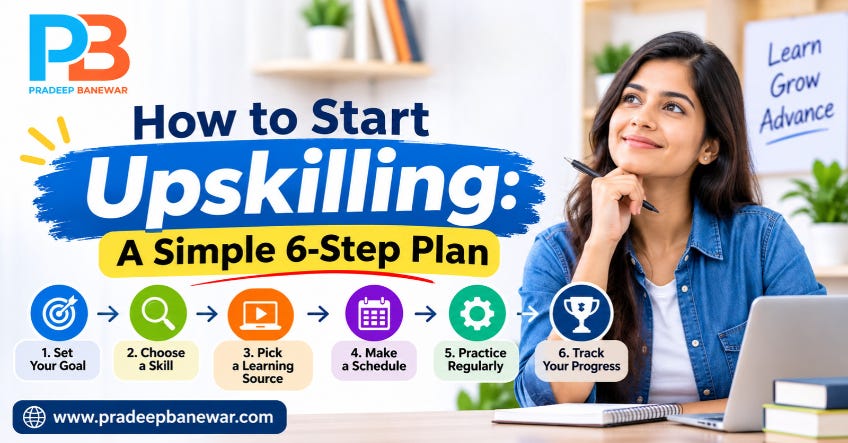
Many people never begin because the whole thing feels too big. Here is an easy path.
Step 1: Pick one goal
Choose one skill that will help your career in the next six months.
Step 2: Check what employers want
Look at ten job postings for the role you want. Notice which skills appear again and again. Those are your targets.
Step 3: Choose a simple learning source
A YouTube channel, a book, or a paid program. The best source is the one you will actually finish.
Step 4: Set a small daily habit
Thirty minutes a day beats a five-hour session once a month. Consistency wins.
Step 5: Practice on real work
Do not just watch tutorials. Apply what you learn on a real task, a small project, or even a personal experiment. This is where learning turns into skill.
Step 6: Track and show your progress
Write down what you learned each week. Share a project. Ask for feedback. Progress you can see keeps you motivated.
Use AI Tools to Learn Faster
Here is a bonus tip. AI tools can act like a patient tutor available at any hour.
You can ask them to:
Explain a hard topic in simple words
Create a practice quiz for you
Review your writing and suggest improvements
Build a weekly study plan
If you are wondering which tools deserve your money, take a look at AI tools worth paying for before you subscribe to anything.
Remember, AI should support your thinking, not replace it. Use it to learn faster, then do the real thinking yourself.
Common Upskilling Mistakes to Avoid
Even motivated people go off track. Watch out for these traps.
Collecting courses but never finishing them. Ten half-done courses are worth less than one completed course.
Learning without practicing. Knowledge fades quickly if you never use it.
Chasing every trend. Not every new tool is worth your time. Choose what fits your goals.
Waiting for the perfect moment. There is no perfect time. Start small, today.
Comparing yourself to others. Everyone learns at a different speed. Focus on your own progress.
Upskilling Is Also About Mindset
Skills are important, but mindset decides whether you keep going. People with a growth mindset believe they can improve through effort. They see mistakes as lessons, not failures. They ask questions without feeling embarrassed.
If you tell yourself “I am not a tech person” or “I am too old to learn this,” you close the door before you even try. Replace that thought with “I have not learned this yet.” One small word changes everything.