

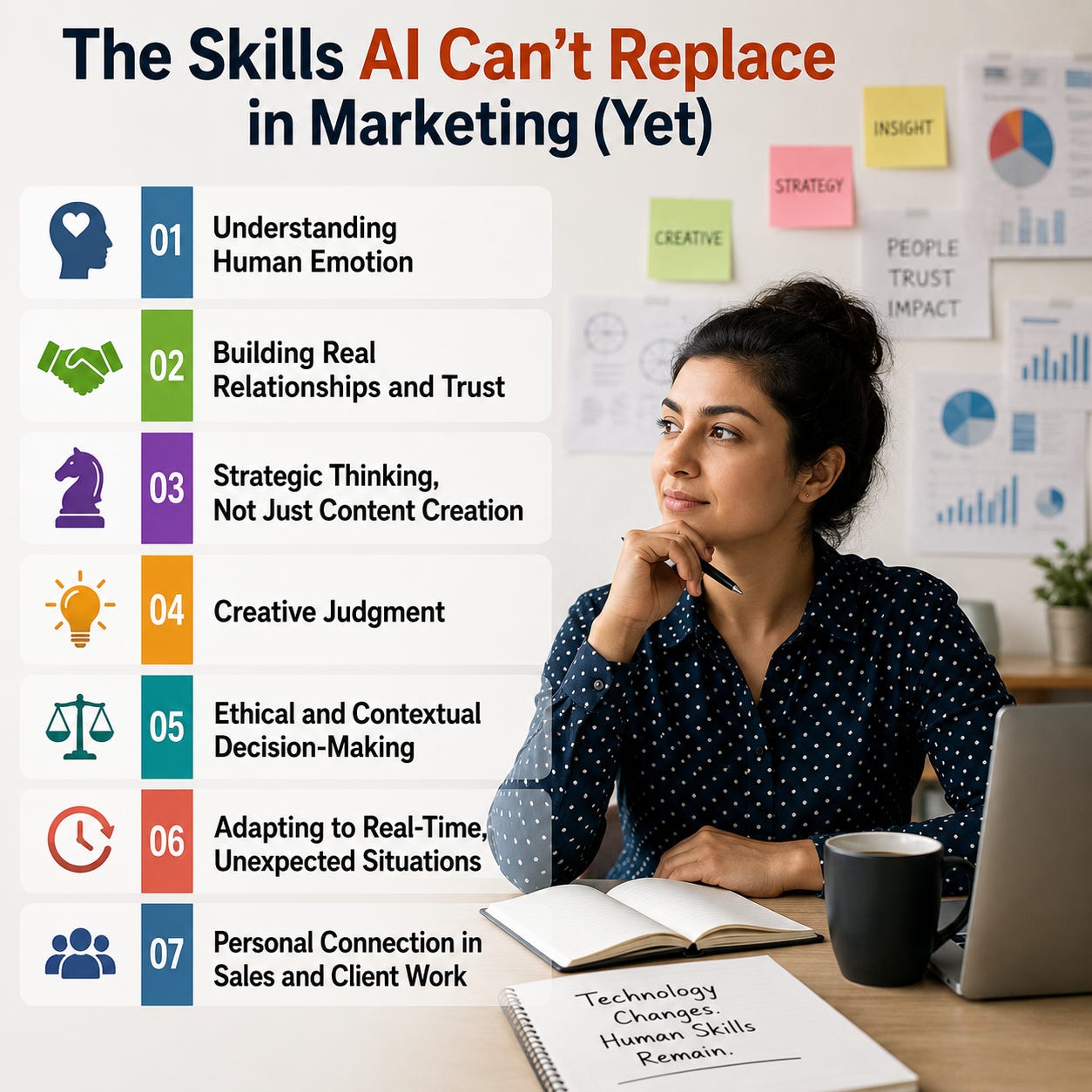
AI can write your captions. It can generate ad copy in seconds. It can even suggest your entire content calendar.
So why are marketers still in demand?
Because marketing is about creating impact, not just content. It was always about understanding people. And that is the one thing AI still struggles to do on its own.
If you’re in marketing and feeling worried about AI taking over, this post is for you. Let’s look at the skills that still need a human, and why they matter more now than ever.
First, Let’s Talk About the Fear Honestly
It’s normal to feel uneasy. Every week brings a new AI tool that promises to “replace” marketers.
But the real story is this. AI is replacing tasks, not marketers.
Writing a blog draft is a task. Understanding what your specific audience actually cares about is a skill. Generating 10 ad ideas is a task. Knowing which one will connect with a skeptical customer is a skill.
This difference matters. In fact, humans will not be replaced by AI, but marketers who refuse to use AI will likely be replaced by marketers who do. The real risk isn’t AI; it’s failing to adapt while everyone else moves forward.
This is also not the first time technology has “threatened” marketing jobs. Search engines, social media, and automation software all changed the day-to-day work. But none of them removed the need for people who understand human behavior. AI is simply the next chapter in that same story.
Skill 1: Understanding Human Emotion
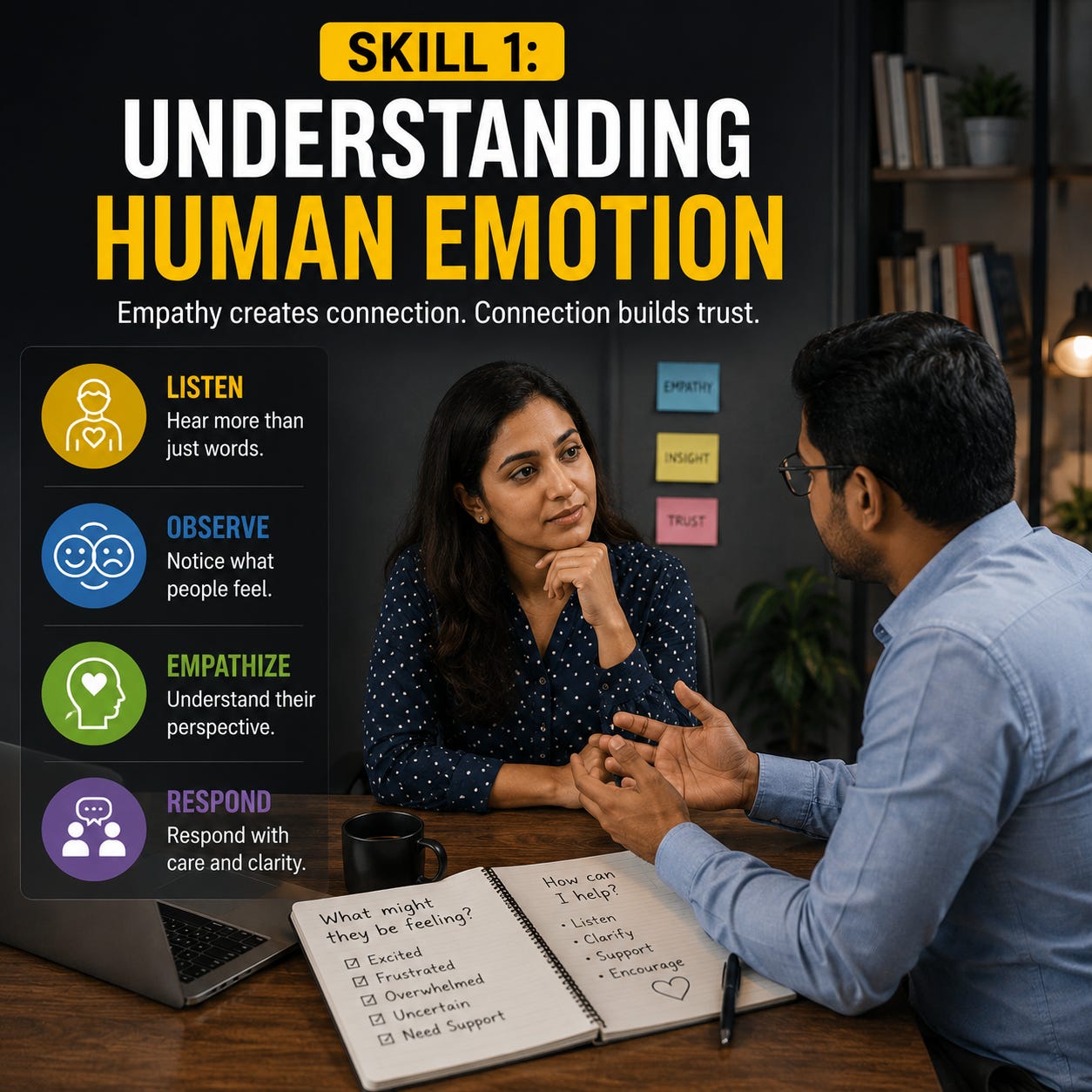
AI can look at data. It cannot feel disappointment, excitement, frustration, or trust the way a human does.
Great marketing connects through emotion, not just information. Pause for a second and think about the last ad you couldn’t ignore. It probably was not the most “optimized” one. It was the one that understood a feeling you already had.
Marketers who can do the following will always have an edge over pure automation:
Read between the lines of customer complaints
Sense when messaging feels wrong, even when the data looks fine
Understand cultural context and sensitivity
This shows up clearly around cultural or emotional moments, like festivals, celebrations, or local events, where tone matters as much as timing. A festival season marketing guide shows how much care goes into getting seasonal messaging right, something AI still struggles to grasp without human guidance.
Think about how differently a product might need to be marketed during a festive celebration versus a sad news cycle. AI will not automatically know to soften a tone or hold back a promotion. A human has to notice that and make the call.
Skill 2: Building Real Relationships and Trust

AI can send a thousand personalised emails in a minute. But it cannot build a real relationship with a client over coffee, remember their child’s birthday, or sense when a customer is hesitant to say what they really think.
Trust is not generated. It is earned slowly, through honesty and consistency.
Clients want to know a real person is accountable for results
Customers trust brands more when they feel human, not robotic
Long-term partnerships are built on reliability, not just speed
This is exactly why trust has become the real currency in business. No algorithm can replace the feeling of being understood by another person.
Skill 3: Strategic Thinking, Not Just Content Creation
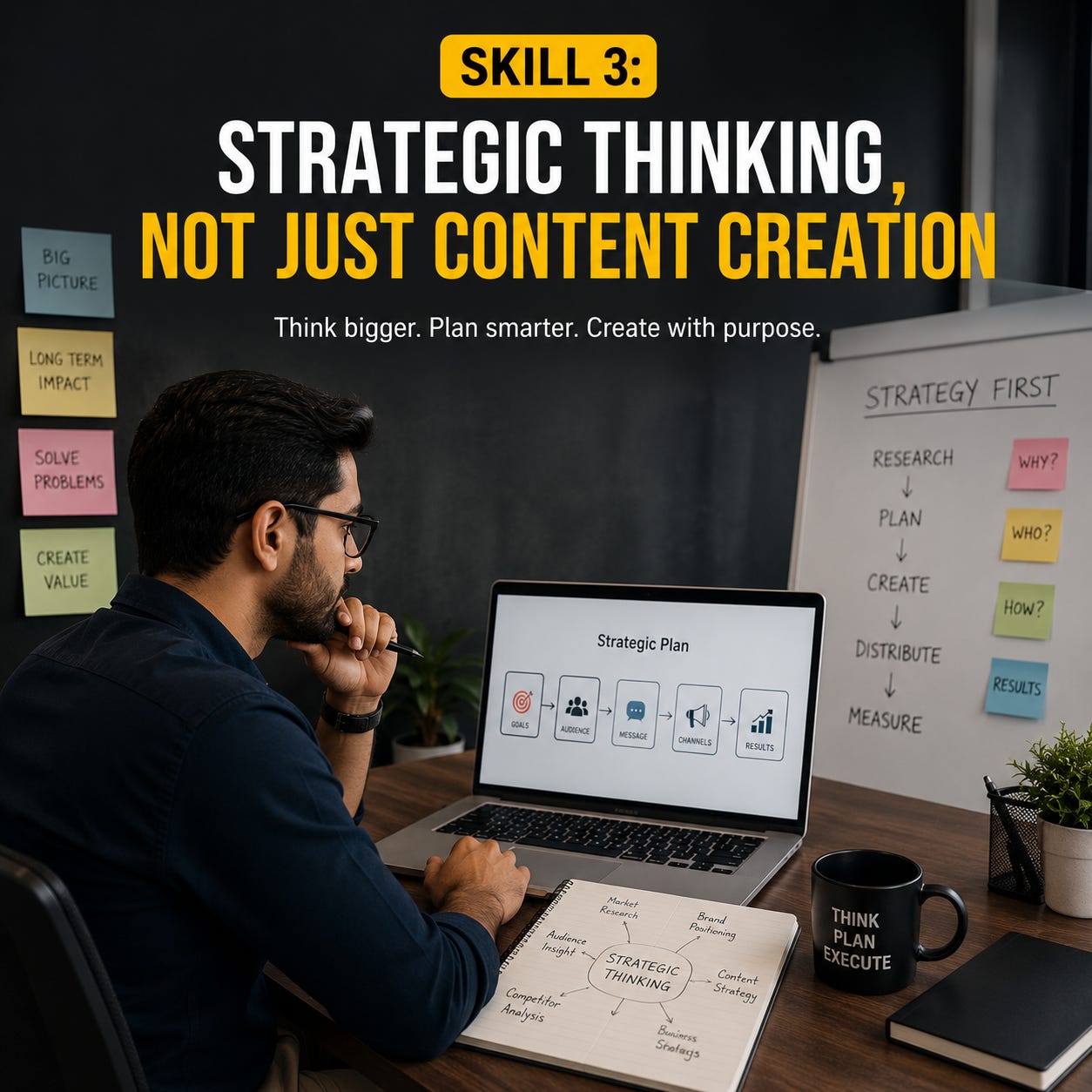
AI is very good at execution. It is still weak in strategy.
Ask AI to “create a marketing plan,” and it will give you a decent generic outline. But it will not know:
Your specific business limits
Your customer’s real objections
Which campaigns already failed, and why
Which risks are worth taking for your brand specifically
Strategy needs context, judgment, and experience. These are things AI does not have on its own. It only has what you give it.
This is why marketers who understand the full picture, from awareness to purchase, remain valuable. Mapping a real customer buying journey from awareness to purchase needs real observation of behaviour, not just prompts.
A good strategist also knows when to break the “best practice” rules. AI tends to suggest the safest option based on data. But sometimes the right move for your brand is the unusual one. Knowing when to take that risk comes from experience, not data alone.
Skill 4: Creative Judgment
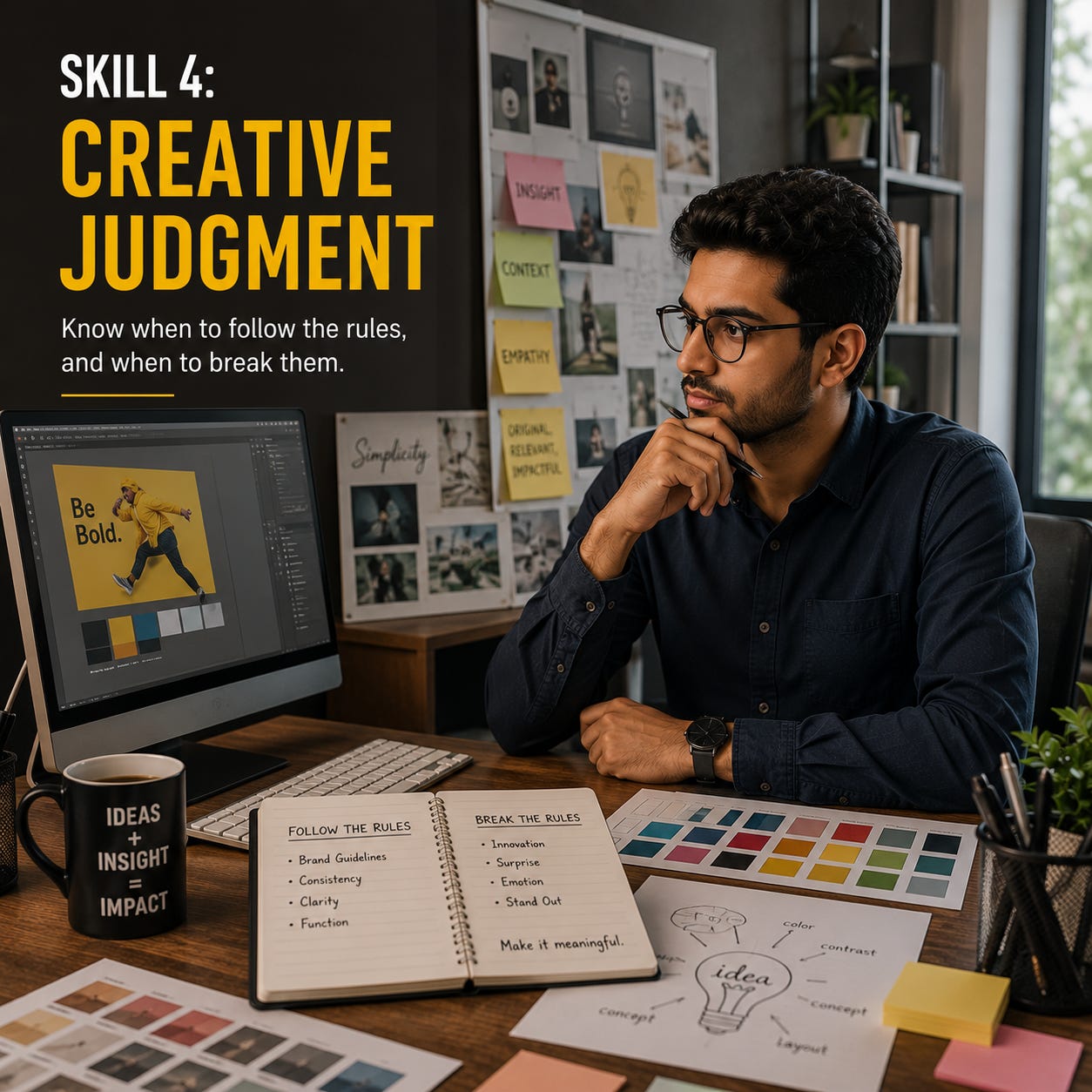
AI can generate hundreds of design or content ideas. But it cannot reliably tell you which one is actually good for your brand, your audience, and this specific moment.
Creative judgment includes:
Knowing when an idea feels too safe or too risky
Noticing when content matches brand voice, or clashes with it
Understanding what will offend, confuse, or delight a specific audience
Choosing the right idea out of ten average ones
AI is a good brainstorming partner, but not a creative director. The final call, the one with real consequences, still needs a human making it.
Skill 5: Ethical and Contextual Decision-Making
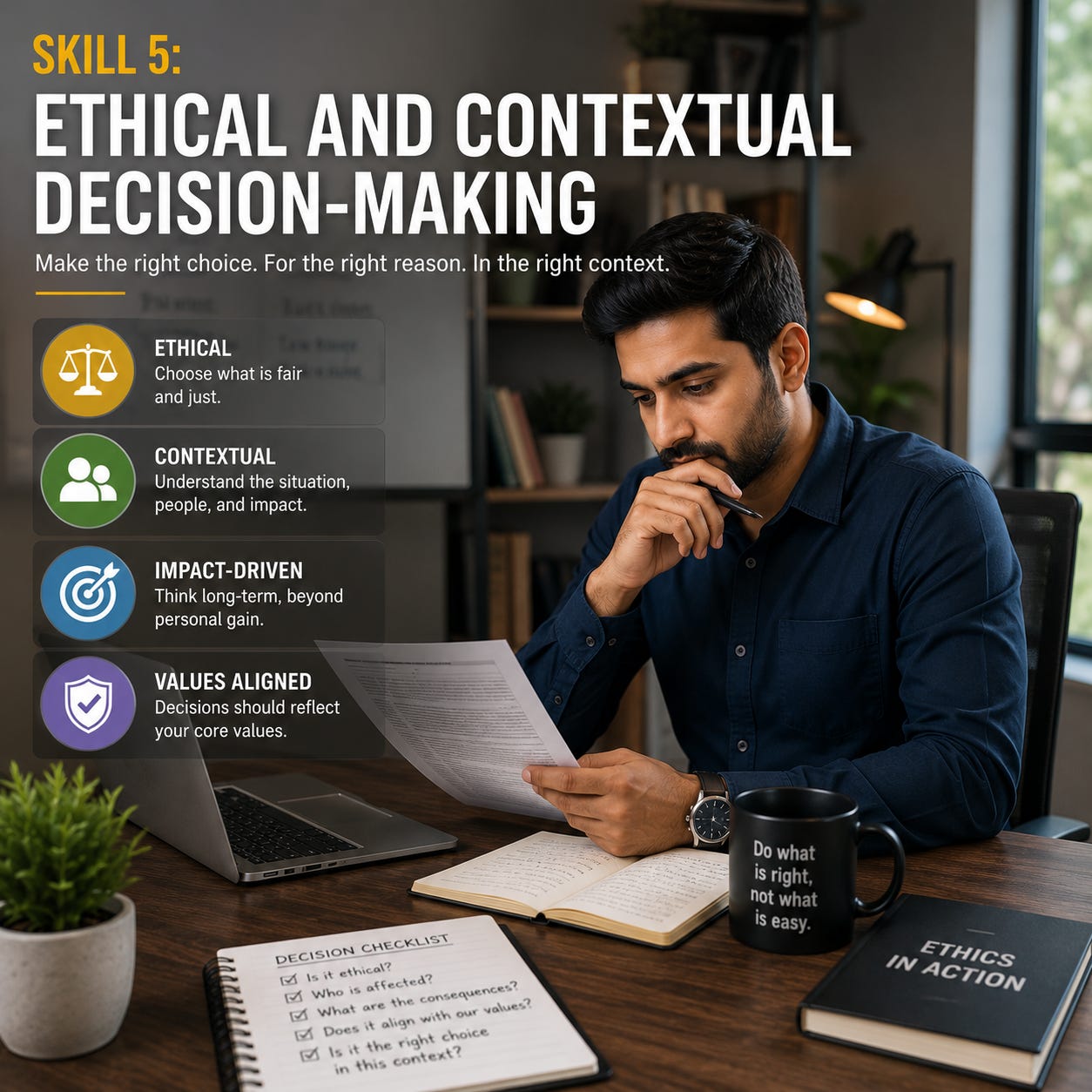
AI does not understand consequences the way humans do. It can produce content that is technically correct but ethically questionable, tone-deaf, or simply wrong for the moment.
Marketers still need to:
Decide what is appropriate to say, and what is not
Catch bias or insensitivity before it goes live
Understand when a campaign could backfire, even if the numbers look good
Balance business goals with real customer wellbeing
This human filter is often invisible. You only notice it when it is missing, and a brand publishes something it deeply regrets.
Skill 6: Adapting to Real-Time, Unexpected Situations
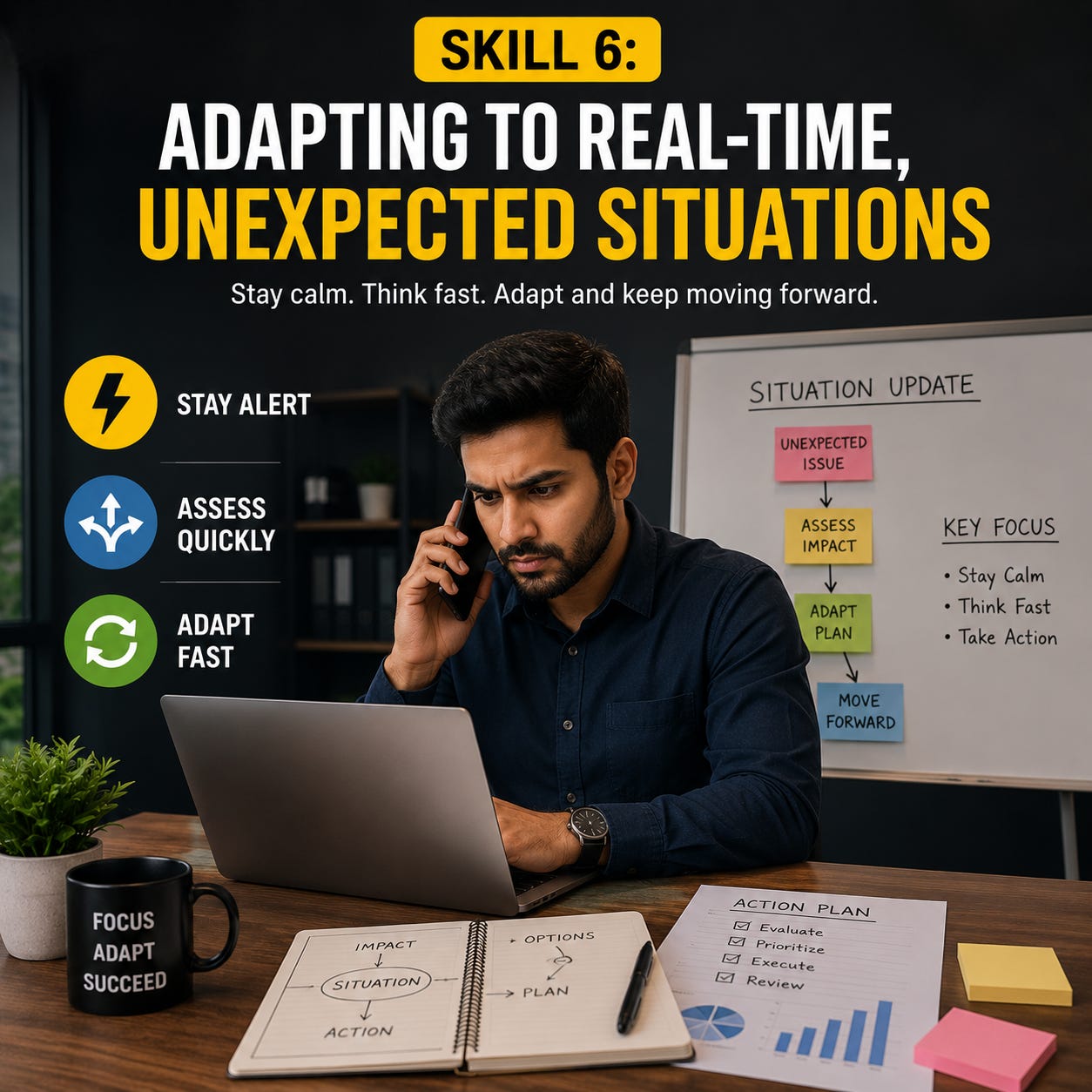
AI works well with patterns it has already seen. It struggles with truly new situations, such as a PR crisis, a sudden cultural shift, a competitor’s surprise move, or an unexpected customer reaction.
Human marketers can:
Read a room, both literally and figuratively
Change messaging within hours based on instinct and experience
Make judgment calls with incomplete information
Stay calm in high-pressure situations
No AI tool today can replace the instinct built from years of handling real, messy, unpredictable markets.
Think back to any brand that handled a crisis well. It was not a scripted response created in seconds. It was a careful, human decision about what to say, what to hold back, and when to stay quiet. That kind of judgment cannot be automated because every crisis is different from the last one.
Skill 7: Personal Connection in Sales and Client Work
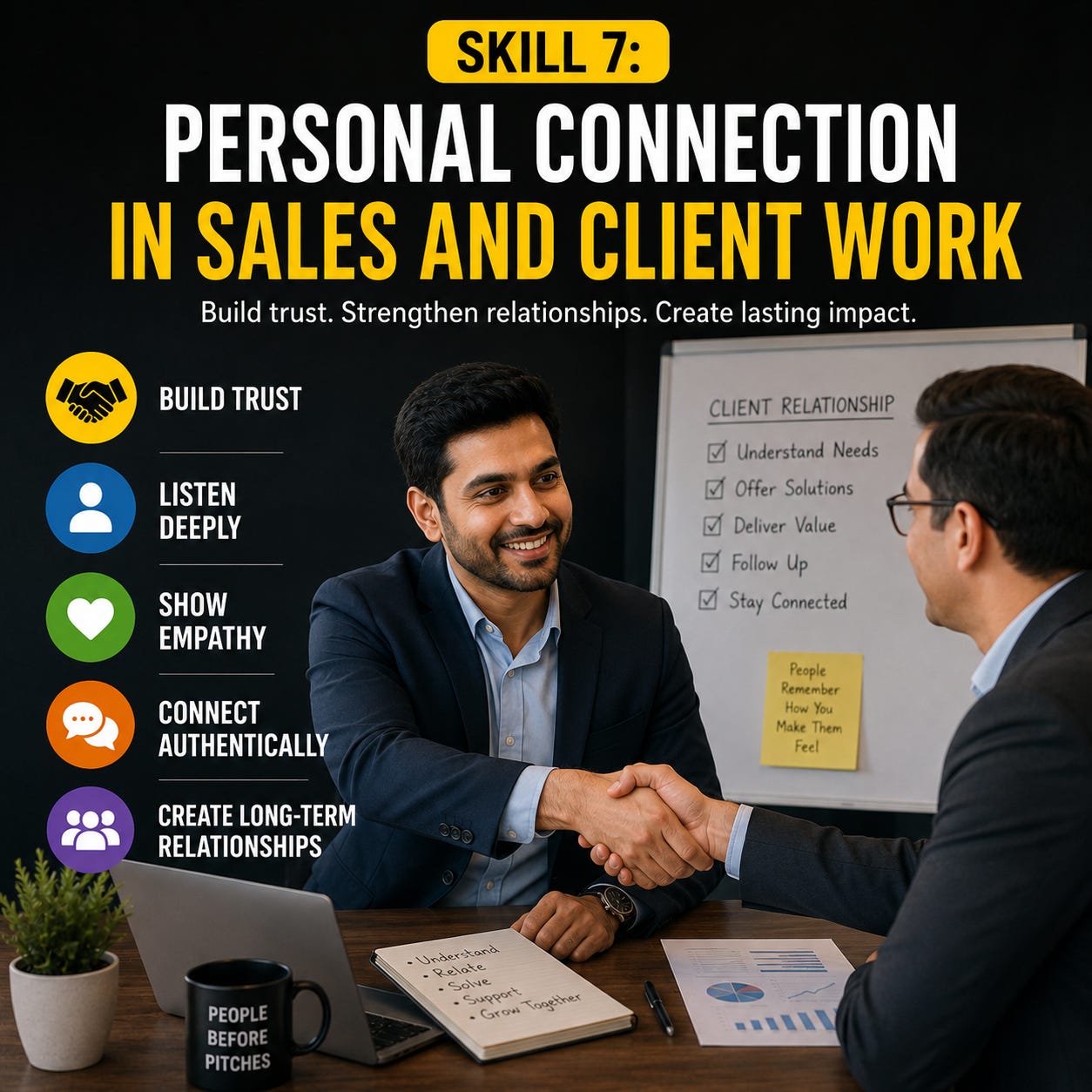
For freelancers and consultants, trust is just as valuable as skill. Clients choose professionals they feel confident working with.
A discovery call where you truly listen
Noticing unspoken hesitation on a client’s face
Adjusting your pitch based on someone’s tone or body language
Delivering a custom strategy built around their specific needs, not a standard template
If you are deciding between freelancing, a job, or building your own business, it helps to understand the real differences between freelancing, a job, and business. This can help you see where these human-first skills matter most for your career path.
So, Where Should AI Actually Be Used?
To be clear, this is not an anti-AI article. AI can be incredibly helpful for:
Generating initial content drafts
Research and quick summaries
Repetitive tasks like formatting and scheduling
Generating ideas quickly
Basic data analysis
The best marketers today don’t choose between AI and human expertise; they combine both to achieve better results. If you want a practical starting point, this list of free AI tools worth using is a good place to explore what is actually useful and what is just hype.
If you are curious about how different AI models compare for marketing tasks, this comparison of ChatGPT vs Gemini vs Claude for marketing breaks down their real strengths and weaknesses.
How to Future-Proof Your Marketing Career?
Instead of fearing AI, focus on strengthening the skills it cannot easily copy:
Sharpen your strategic thinking: Learn to connect data to real business decisions, not just numbers.
Invest in relationship building: Clients and customers remember how you made them feel.
Develop strong creative judgment: Practice deciding, not just generating.
Stay culturally aware: Understand your audience’s context deeply, not just their demographics.
Get comfortable with uncertainty: Real markets are messy. AI prefers patterns. Humans do well in uncertainty.
AI is reshaping every industry, marketing included. Understanding how AI is reshaping industries broadly can help you prepare for where your specific role is headed next, instead of being caught off guard.
If you are early in your career, or thinking about where to specialise, it also helps to look at which IT and digital career paths are growing alongside AI rather than shrinking because of it. Roles that combine human judgment with AI skills consistently show the strongest long-term demand.
Why Does This Matter More Than Ever Right Now?
Marketing tools change every year. What does not change as fast is the underlying skill of understanding people. This is why marketers who invest in these human skills today will still be relevant in five or ten years, no matter which AI models come and go.
This should also change how you learn. Instead of only chasing the latest AI tool tutorial, spend equal time on:
Talking to real customers, not just reading their data
Studying how top brands build long-term trust, not just short-term clicks
Practicing decision-making under uncertainty, not just following checklists
Reflecting on past campaigns, what worked, what did not, and why
If you recently finished a digital marketing course and are wondering what to focus on next, it helps to know the common mistakes people make right after finishing a digital marketing course. Many of them come from relying too much on tools and not enough on these greater human skills.
A Simple Way to Think About It
Imagine AI as a highly capable intern. Fast, tireless, and full of ideas. But would you let an intern make your final client decisions, handle a PR crisis, or represent your brand’s values without any supervision?
Probably not.
That is the role AI plays today. It is an assistant, not a replacement. The final judgment, empathy, and strategy still belong to you.
AI is not the end of marketing careers. It is a filter, separating marketers who only complete tasks from marketers who truly understand people.
The skills that matter most right now are not technical prompts or tool mastery alone. They are:
Emotional understanding
Trust building
Strategic thinking
Creative judgment
Ethical decision-making
Real-time adaptability
Genuine human connection
These are the skills AI cannot replace, at least not yet. The marketers who focus on them today will be the ones who thrive, no matter how advanced AI becomes tomorrow.
Want more insights on AI and digital marketing? Explore more on the Pradeep Banewar Blog.