

Your commute is gone. Your boss is a small box on a screen. Your “desk” is the kitchen table.
Now picture the other side: a busy office, quick chats by the coffee machine, and a manager who sees you every day.
Which one helps your career more?
This question splits friends, families, and even whole companies. Some people say remote work gave them their life back. Others say they stopped learning the day they left the office.
Both groups are right, in different ways. The real answer depends on your goals, your habits, and your stage of career.
What Do We Mean by Remote and Office Work?
Let us keep the terms clear.
Remote work: You work from home, a cafe, or a co-working space. You rarely or never visit an office.
Office work: You work from a company location every working day.
Remote work is not new, but it has become far more common. Many roles that once needed a desk now run fully online. If you want a closer look at this shift, read about work from home careers that are growing rapidly.
The Big Advantages of Remote Work
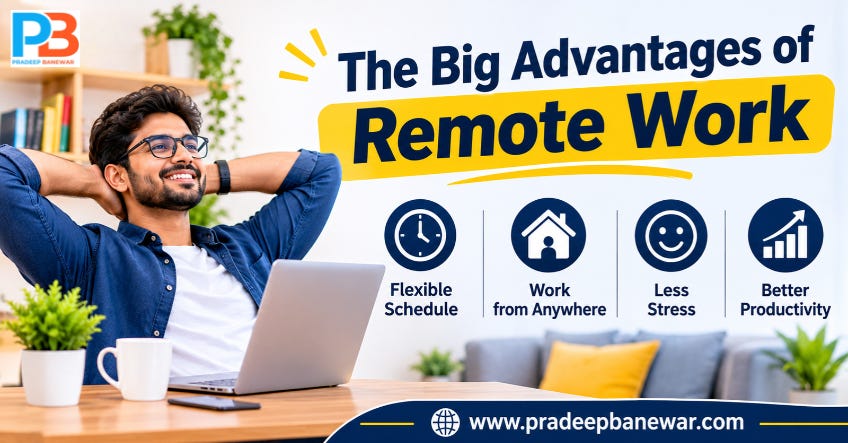
Remote work has real strengths. Here are the ones that matter most for your career.
1. You Get Your Time Back
A long commute can eat 1 to 3 hours a day. Over a year, that is weeks of your life spent in traffic.
When you work remotely, you can use that time to:
Learn a new skill
Exercise or rest properly
Work on a side project.
Spend time with family.
That extra time can quietly build your career over the years.
2. Deep Focus Is Easier
Offices are noisy. Meetings, small talk, and tap-on-the-shoulder questions break your concentration.
At home, you can switch off distractions and finish real work. For jobs like writing, coding, design, or analysis, this is a big win. Creative roles are a good example, and this guide on earning as a graphic designer shows how designers can build a high income from anywhere.
3. A Wider Job Market
Here is a point many people miss. When you work remotely, your job options are no longer limited to your city.
You can apply to companies in other cities or even other countries. That means:
More choice of roles
Better salary options
Access to top teams and brands
You can even go one step further and skip the employer completely. If you are weighing that choice, compare freelancing vs full-time jobs before you decide.
4. Better Work-Life Balance
Happy people usually perform better. Remote work can reduce stress and burnout, especially if you manage your day well.
5. Lower Costs
You may spend less on fuel, food, clothes, and rent if you live in a cheaper area. That saved money gives you the freedom to take career risks, such as switching jobs, starting a side hustle, or investing in a course to learn digital marketing.
The Hidden Problems with Remote Work
Remote work is not perfect. Some of its problems are slow and quiet, which makes them dangerous for your growth.
1. You Can Become Invisible
This is the biggest risk. When managers do not see you, they may forget your effort.
Out of sight can mean out of mind, especially when promotions are discussed.
2. Less Learning by Watching
In an office, you pick up knowledge without trying. You hear how a senior handles a tough client. You see how a team solves a problem.
At home, you only learn what you actively ask for. That is harder for beginners.
3. Loneliness and Burnout
Many remote workers feel isolated. Others cannot stop working because the laptop is always right there. Without a clear routine, the day blurs into night.
4. Weaker Team Bonds
Trust grows faster when people meet face to face. Remote teams can feel more like a group of strangers doing tasks.
5. Home Distractions
Family, chores, poor internet, and a messy space can all hurt your output.
The Big Advantages of Office Work

Now let us give the office its fair credit.
1. Faster Learning
If you are early in your career, the office is a strong classroom. You can:
Ask quick questions
Watch experienced people work.
Get instant feedback
Learn the unwritten rules of the company.
This kind of learning is hard to copy on video calls.
2. Strong Relationships
Friendly chats over lunch or tea build real trust. Those relationships often lead to help, support, and new opportunities.
People who like you and trust you will speak up for you when you are not in the room.
3. Better Visibility
When leaders see your work and attitude daily, they remember you. That helps when new projects, raises, and promotions come up. If you are curious about what really drives faster promotions, this piece on why some people get promoted faster is worth your time.
4. Clear Work and Home Boundaries
When you leave the office, work stays there. For many people, this makes it easier to switch off and rest.
5. Easier Teamwork
Brainstorming, quick decisions, and fixing problems are often faster when everyone is in one room.
The Downsides of Office Work
The office has its own price tags.
Commute stress: Time, money, and energy are lost on the road.
Less flexibility: Fixed hours can clash with personal life.
Distractions: Noise and constant interruptions hurt deep work.
Office politics: Some workplaces reward loud people instead of good work.
Higher living costs: Jobs in big cities often mean expensive rent.
For some people, these costs are too high. For others, they are a fair trade for the learning and connection.
Which Gives Faster Promotions?
This is the question most people really want answered.
Many studies and workplace surveys suggest that people who are seen more often can have an edge in promotions. This is sometimes called “proximity bias.” It means managers may favor those they see daily, even when remote workers perform equally well.
But this is not a rule. Remote workers can still rise quickly if they do these things:
Share results clearly. Send short weekly updates about what you finished.
Speak up in meetings. Do not hide behind a muted mic.
Ask for feedback. Show that you care about improving.
Take on visible projects. Work that matters to the company gets noticed.
Build your online presence. A strong professional profile helps recruiters and leaders find you. Here is a guide to creating a LinkedIn profile that recruiters cannot ignore.
The lesson is simple: being remote means you must work harder at being seen.
Which Is Better for Learning New Skills?
For beginners, the office usually wins. You learn faster when you are surrounded by people who know more than you.
For experienced workers, remote can work just as well, or even better. You can pick your own courses, use online tools, and learn at your own pace.
If you are choosing between jobs, it also helps to ask yourself whether you want more money or more learning right now. This breakdown of better pay vs better learning in a job can help you think it through.
What About Pay?
Pay depends more on your skills, role, and company than on where you sit.
Still, there are some patterns:
Remote jobs with global companies can pay well, since you are not limited by local salaries.
Some companies cut pay for people who live in cheaper areas.
Office jobs in big cities may pay more but come with higher living costs.
Always look at take-home value, not only the salary number. Count your travel, food, and rent too.
Remote work also makes it easier to build extra income. You can use your saved time for freelancing, content, or a small business. If that idea excites you, read about how to build multiple income sources online.
Who Should Choose Remote Work?
Remote work may suit you if you:
Are self-disciplined and good at planning
Communicate clearly in writing.
Have some experience in your field.
Like working alone for long periods
Want flexibility and a wider job market.
Who Should Choose Office Work?
Office work may suit you if you:
Are a fresher or early in your career
Learn best by watching and asking.
Enjoy people and team energy.
Struggle to stay focused at home.
Want faster visibility with leaders.
Common Myths
Myth 1: Remote workers are lazy.
Reality: Many remote workers work longer hours because they struggle to log off.
Myth 2: Office workers always get promoted faster.
Reality: Visibility helps, but results and communication matter more.
Myth 3: Remote work is only for experts.
Reality: Beginners can work remotely too, but they need extra effort to learn and connect.
Myth 4: Hybrid is always the best option.
Reality: It depends on how well your company runs it.
So, Which One Should You Choose?
If you are just starting, the office can speed up your learning and help you build a strong base. If you are experienced and self-driven, remote work can give you freedom, focus, and better options.
If you want a balance, hybrid is a smart middle path.
But remember this: the place you work matters less than how you work. A remote employee who communicates well, delivers results, and keeps learning can outgrow an office employee who does the bare minimum. The reverse is also true.
Pick the setup that fits your personality and your current goals. Review it every year, because your needs will change. And whichever you choose, stay curious, stay visible, and keep building skills.