

Imagine waking up on Monday morning without worrying about reaching the office on time. You open your laptop, choose your tasks, and start working according to your schedule. Now imagine another Monday where you receive a fixed salary, work with a team, and know exactly what your responsibilities are.
Both lifestyles have their advantages. One offers flexibility, while the other provides stability.
But when it comes to freelancing vs. full-time jobs, which career path is better?
The answer depends on your skills, financial situation, personality, and long-term goals. Some people enjoy the independence of freelancing, while others prefer the structure of a full-time job.
In this article, we will compare both career paths, explore their advantages and disadvantages, and help you decide which option suits you best.
What Is Freelancing?
Freelancing means working alone and delivering services to further clients. Instead of working permanently for one employer, you complete projects or assignments based on agreements with your clients.
For example, a freelance content writer who has completed a content writing course may write blog posts for several companies, while a freelance digital marketer may manage SEO campaigns for multiple businesses.
Popular freelancing fields include:
Content writing and copywriting
Digital marketing and SEO
Graphic design and video editing
Website development
Social media management
Consulting and virtual assistance
Freelancers often have greater control over their working hours, clients, and projects. However, they must also find work, negotiate prices, manage payments, and handle business expenses.
You are not just responsible for completing projects. You must also manage your professional growth.
What Is a Full-Time Job?
A full-time job means working for an employer under an agreed employment arrangement. You generally receive a regular salary in exchange for completing assigned responsibilities.
Full-time workers can work remotely, in an office, or in a hybrid setting.
For example, a digital marketing executive might work for one company, improve its website rankings, manage advertising campaigns, and report results to a manager.
Full-time employment can provide a predictable salary, defined responsibilities, teamwork, and opportunities for promotion. Some employers also offer paid leave, insurance, retirement benefits, and professional training.
However, employees usually have less control over their schedules and assignments.
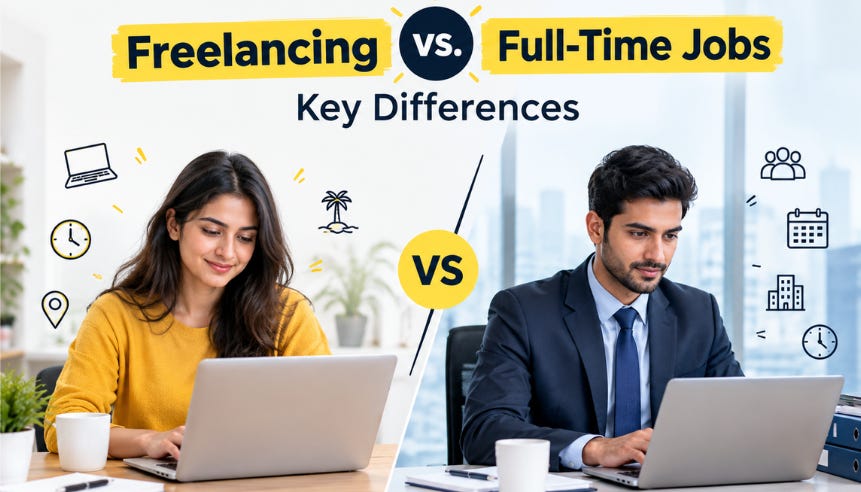
Freelancing vs. Full-Time Jobs: Key Differences
1. Income: Which Career Offers Better Earning Potential?
One of the most important considerations when selecting a career is money. However, your earning potential is determined by your industry, expertise, abilities, and capacity to produce outcomes.
Freelancing income
Freelancers can increase their income by taking on more projects, improving their skills, and charging higher rates.
For example, a freelance SEO specialist might start with small projects and gradually work with businesses that need ongoing SEO services.
Freelancers can also work with multiple clients instead of depending on one employer.
However, income is not always consistent. Some months may bring several projects, while others may offer fewer opportunities. Freelancers must also cover expenses such as software, equipment, taxes, and marketing.
Full-time job income
Employees generally receive a regular salary, making monthly budgeting easier. They may also earn bonuses, commissions, and salary increases.
With experience, they can move into senior positions, management roles, or specialised departments.
However, salary growth may depend on company policies, promotion opportunities, and performance reviews.
When comparing job offers, consider both your immediate salary and the opportunities to develop valuable skills. Read Better Pay vs. Better Learning: Which Job Should You Choose to understand why long-term learning also matters.
Verdict: Freelancing offers flexible earning potential, while full-time employment usually provides greater income predictability.
2. Work-Life Balance: Freedom or Routine?
A good career should support your life rather than control it.
Freelancing allows you to organise your schedule around personal responsibilities. You may work early in the morning, take breaks when needed, or avoid commuting by working remotely.
However, flexibility can become a problem when you accept too many projects. Late-night deadlines and weekend work can affect your personal life.
Full-time jobs offer more structure. Employees often have established working hours, scheduled leave, and weekends off, depending on their workplace.
On the other hand, long commutes, overtime, and demanding managers can make work-life balance difficult.
Verdict: Freelancing suits people who value schedule flexibility, while full-time jobs may suit those who prefer a predictable routine.
3. Job Security: Is a Regular Salary Always Safer?
Financial security becomes especially important when you have family responsibilities, monthly bills, or other financial commitments.
A full-time job generally provides more predictable short-term income. You know your expected salary and can plan your expenses accordingly.
However, employment is not completely risk-free. Companies can reduce staff, restructure departments, or close operations.
Freelancers face different challenges. Clients may cancel projects, delay payments, or stop requiring their services.
To reduce these risks, freelancers should:
Build an emergency fund.
Maintain relationships with previous clients.
Avoid depending entirely on one client.
Develop skills that businesses need.
Plan expenses around changing income.
Employees can benefit from these financial habits too.
Verdict: A regular salary can make financial planning easier, but long-term security also depends on savings, skills, and adaptability.
4. Career Growth: Which Path Helps You Learn Faster?
Career growth is about more than earning money today. It is also about developing skills that create better opportunities tomorrow.
Growing through full-time employment
Full-time jobs can provide structured training, experienced colleagues, mentorship, and opportunities to work on larger projects.
You may learn teamwork, communication, leadership, and problem-solving while understanding how a business operates.
However, growth depends on the workplace. Some companies offer excellent development opportunities, while others provide limited training or promotion prospects.
Career progression also depends on how you handle responsibilities, communicate with colleagues, and contribute to your team. Explore Why Some People Get Promoted Faster to understand the habits that can support professional growth.
Growing through freelancing
Freelancers often work with different clients and solve a variety of business problems.
For example, an SEO freelancer might improve website rankings for one client, research competitors for another, and develop content strategies for a third.
This variety can help freelancers develop practical knowledge and business skills.
However, they must find learning opportunities independently and invest in their professional development.
For more insights, read The Skill Nobody Teaches You in College.
Verdict: Full-time employment offers structured learning, while freelancing can provide varied practical experience. Both can support long-term career growth.
5. Stress and Responsibility: Which Is More Difficult?
Some people believe freelancing is easier because there is no boss. Others think full-time jobs are stressful because of deadlines and office politics.
The reality is different for everyone.
Freelancers must find clients, negotiate prices, manage invoices, follow up on payments, and complete projects on time. When business slows down, financial uncertainty can become stressful.
Full-time employees may face demanding managers, workplace conflicts, strict deadlines, and limited control over assignments.
Freelancing gives you more independence but also more responsibility. Full-time employment provides an established structure but requires you to work within company expectations.
Verdict: Neither career is automatically less stressful. Consider which type of responsibility you can manage comfortably.
6. Skills You Need to Succeed
Both career paths require technical knowledge, communication, time management, and problem-solving skills.
For full-time jobs, employers commonly look for:
Relevant technical knowledge.
Teamwork and communication.
Reliability and professionalism.
Willingness to learn.
Freelancers need these skills too, along with client management, negotiation, portfolio development, and marketing their services.
For example, knowing SEO is useful, but it does not make you a prosperous freelancer. You must also understand client expectations, explain your strategy, demonstrate results, and manage projects professionally.
Similarly, employees who communicate well and solve problems are often better prepared for leadership opportunities.
Verdict: Technical skills help you get started, but communication, reliability, and practical experience help you grow in either career.
7. Which Career Is Better for Beginners?
If you are a student, recent graduate, or someone changing careers, choosing between freelancing and full-time employment can feel confusing.
For many beginners, a full-time job provides a useful starting point. It offers practical experience, exposure to professional expectations, and chances to learn from skilled coworkers.
Freelancing can also work for beginners who already have a marketable skill and can demonstrate their abilities.
However, finding the first few clients may take time. You might need to build a portfolio, approach potential clients, and learn how to price your services.
A practical starting plan is to:
Choose one skill that businesses are willing to pay for.
Build a portfolio using practice projects or legitimate client work.
Improve your communication and time management.
Apply for jobs or approach potential clients.
Learn from feedback and improve your work.
If you are entering digital marketing, explore Top 5 Mistakes After a Digital Marketing Course.
Verdict: A full-time job can provide a strong foundation, while freelancing can help you gain independence when you have the necessary skills.
8. Can You Freelance Alongside a Full-Time Job?
Yes. Combining employment with freelancing can be a practical way to explore both options.
You continue earning your salary while testing whether you can attract clients and generate additional income.
For example, a full-time content writer might accept a few writing projects outside working hours. A digital marketing executive might build a portfolio by helping independent clients.
This approach can help you:
Gain additional experience.
Develop a second income source.
Build a professional network.
Test whether freelancing suits you.
Save money before changing careers.
However, check your employment contract and company policies before accepting outside work. Protect confidential information, avoid conflicts of interest, and ensure your side projects do not affect your main responsibilities.
Start with a manageable workload and increase it only when you can handle both commitments comfortably.
9. How AI Is Changing Both Career Paths
Artificial intelligence is changing how professionals work in writing, marketing, design, research, and software development.
Freelancers can use AI tools such as ChatGPT, Google Gemini, Claude, and Perplexity AI to research topics, organise projects, prepare initial drafts, and automate repetitive tasks.
Full-time employees can use similar tools to improve productivity, analyse information, and complete routine work more efficiently.
However, AI also means that professionals must continuously improve their skills. Simply knowing how to use a tool is not enough. Understanding problems, checking accuracy, making decisions, and delivering useful results remain important.
Focus on combining technical knowledge with creativity, critical thinking, communication, and judgement.
Read How AI Is Changing the Future of Digital Marketing to learn more about these changes.
Verdict: Whether you freelance or work full-time, staying adaptable and learning new skills can help you remain competitive.
10. When Should You Choose Freelancing?
Freelancing may suit you if you value independence and are comfortable managing your own work.
Consider freelancing if:
You have a skill that clients are willing to pay for.
You enjoy working independently.
You want greater control over your schedule.
You can communicate professionally with clients.
You can manage uncertain income.
You are willing to find new projects regularly.
Before leaving a full-time job, consider your savings, monthly expenses, existing clients, and expected income.
Do not switch simply because freelancing looks easier or more exciting. Independent work requires patience, discipline, and consistent effort.
You can also read How to Build Multiple Income Sources Online for ideas about diversifying your income.
11. When Should You Choose a Full-Time Job?
A full-time job may be a better choice if you prefer stability, teamwork, and structured professional development.
Consider employment if:
You need predictable monthly income.
You are beginning your career.
You prefer working with a team.
You value mentorship and training.
You want opportunities for promotion.
You prefer not to manage client acquisition.
You need employer-provided benefits, where available.
A good job can help you develop expertise, build professional relationships, and save money.
These advantages can support your future, whether you remain employed or eventually move into freelancing or business.
Remember that choosing a job does not mean giving up your ambitions. You can build a successful and rewarding career through employment.
12. Freelancing, Job, or Business: Think Beyond Today
Your career decision does not have to be permanent.
Some professionals start with full-time jobs, gain experience, and move into freelancing later. Others freelance for years before choosing employment because they prefer predictable income or teamwork.
Some eventually build businesses that operate beyond their individual working hours.
Freelancing generally involves selling your personal skills and services. Running a business may involve developing systems, building a team, and creating services or products that can grow beyond your own time.
Think about where you want to be in the next three to five years, not just what seems attractive today. For a broader comparison, read Freelancing vs. Job vs. Business.