

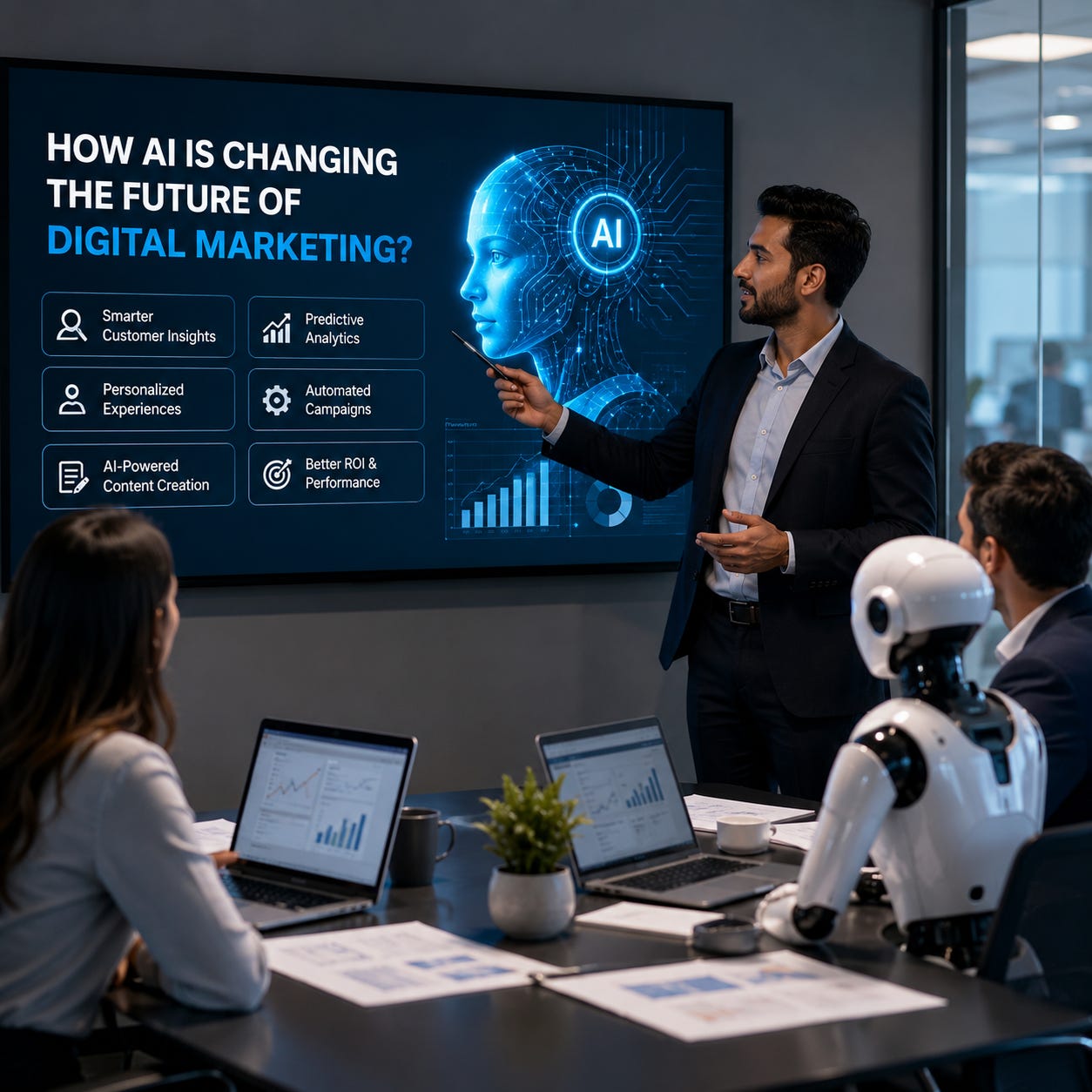
A few years ago, if you told a marketer that a machine would write ad copy, predict customer behaviour, and run campaigns automatically, they would have laughed.
Nobody is laughing now.
AI has quietly walked into every corner of digital marketing, and it is not leaving. From the ads you see on Instagram to the emails landing in your inbox, AI is working behind the scenes, making decisions faster than any human team ever could.
The question is no longer “Will AI change marketing?”
The question is: are you keeping up?
The Scale of What’s Already Happening
This is not a future trend. It is happening right now.
Over 92% of marketers across the globe now use AI tools as part of their marketing process.
Brands using AI personalisation strategies can boost their marketing performance and ROI by up to 30%.
Businesses using AI for customer engagement report significantly higher conversion rates.
Content creation, ad targeting, SEO, and email marketing have all been touched by AI.
And in India, where digital adoption is exploding, this shift is happening at an even greater scale. Small businesses, solo creators, and large brands are all scrambling to figure out how to use AI before their competitors do.
If you are still doing everything manually, writing every caption, guessing every ad audience, sending the same email to every subscriber, you are working much harder than you need to.
1. Content Creation: Faster, Smarter, But Still Human
Let’s start with the most obvious one.
AI tools such as ChatGPT, Gemini, and Claude can now create blog articles, social media posts, email campaigns, and video scripts within minutes. Tasks that previously stretched across the day can now be finished much faster, often within an hour.
But this is important: AI content without a human voice is content nobody remembers.
Winning brands are not replacing writers with AI. They are the ones using AI to handle the first draft, the structure, the research, and then adding real opinions, real stories, and real personality on top.
If you want to write blogs that actually rank and get read, here is a full breakdown of how to use AI to write blogs that rank on Google without sounding like a robot before you publish your next post.
Winning in content creation in 2026 is not about replacing humans with AI, but using AI to strengthen human creativity.
2. SEO: AI Is Rewriting the Rules
Search engine optimisation used to be about stuffing the right keywords into your page and hoping Google noticed.
Those days are over.
AI has made Google smarter. It now understands the intent behind a search, not just the words. The algorithm rewards content that solves real problems, not content that only looks optimised on paper.
Thanks to AI-powered tools, even beginners can now handle SEO tasks more efficiently and:
Use AI to discover the exact questions your audience is actively searching for online.
Generate topic clusters and content plans in minutes.
Identify gaps in your content that competitors are filling.
Write meta titles and descriptions that actually get clicks.
The bigger shift is this: AI-generated search results like Google’s AI Overviews are changing how people consume search results altogether. Getting to the top of Google now means creating content so thorough and trustworthy that even AI summaries point back to you.
If you are still deciding between SEO, social media, or Google Ads, AI is making it easier to figure out which channel actually works for your business.
3. Personalisation: Every Customer Gets a Different Experience
When Amazon suggests products that match your interests, or Netflix recommends a show you end up bingeing, AI personalisation is working behind the scenes.
Now, that same technology is available to businesses of every size.
AI can analyse customer behaviour, what they clicked, what they ignored, how long they stayed on a page, and automatically show them the most relevant content, product, or offer.
This means:
Your email subscriber who clicked on “SEO tips” gets a follow-up about SEO, not a generic newsletter.
Your website visitor who browses your pricing page gets retargeted with a testimonial ad, not a brand awareness post.
Your WhatsApp broadcast reaches different customer segments with different messages, automatically.
Personalisation used to require a big team and a big budget. AI has made it something even a solo marketer can do.
Understanding the customer buying journey from awareness to purchase becomes much more powerful when AI is helping you deliver the right message at every stage.
4. Paid Advertising: AI Is Running the Show
If you have ever run Google Ads or Meta Ads, you have already been using AI, whether you knew it or not.
Both platforms now use machine learning to decide:
Who sees your ad and when
Which version of your ad performs best
How to allocate your budget across placements
When to push harder and when to pull back
Manual bidding and hand-picked audiences are becoming obsolete. AI optimises ad delivery in real time, testing thousands of combinations that no human could manage.
The marketer’s job is shifting. Instead of micromanaging every setting, you now need to:
Feed the algorithm high-quality creative.
Give it a clear objective and enough budget to learn.
Analyse the results and make strategic decisions.
AI handles the execution. You handle the strategy.
5. Social Media: Content, Scheduling, and Analytics on Autopilot
Social media marketing used to be exhausting. Post every day, check your analytics, figure out what worked, then repeat.
AI has changed all three parts of that loop.
Content: AI tools can now suggest post ideas based on trending topics in your niche, generate captions, and even create short video scripts tailored to your audience.
Scheduling: AI-powered tools analyse when your specific audience is most active and schedule posts for maximum reach. No more guessing the best time to post.
Analytics: Instead of drowning in data, AI summarises what is working, what is not, and what you should do next.
The platforms themselves, Instagram, YouTube, and LinkedIn, are all using AI to decide which content gets pushed to more people. Understanding how these algorithms work is now a core marketing skill.
The battle between Instagram Reels and YouTube Shorts is also being shaped by AI, with both platforms using it to keep viewers watching longer and reward creators accordingly.
6. WhatsApp Marketing: AI Making It Smarter
In India, especially, WhatsApp is not just a messaging app. It is a sales channel.
AI is now making WhatsApp marketing sharper than ever:
AI-driven chatbots provide 24/7 customer assistance without requiring someone to manually respond every time.
AI-powered follow-ups deliver the right message at the right stage of the customer journey.
Smart segmentation allows businesses to personalise broadcasts for specific groups rather than sending them to all contacts.
If you are a small business or freelancer using WhatsApp to get clients, this WhatsApp marketing guide shows you exactly how to set this up, with or without a big budget.
7. The Rise of the AI-Powered Solo Marketer
Here is what is most exciting about all of this.
AI is flattening the playing field.
A solo creator or small business owner in 2026 can now do what used to require an entire marketing team. Write content, run ads, manage social media, personalise emails, analyse data, and optimise campaigns, all with the help of AI tools.
This means:
You can now run powerful marketing campaigns without needing ten different employees.
You do not need a massive budget to compete with established players.
You do not need to understand complex technology to take advantage of AI-powered tools.
What you do need is the right knowledge, the right tools, and the discipline to stay consistent.
If you are building this from scratch, a zero-budget digital marketing strategy for small businesses is a great place to start, and AI makes every step of it easier.
What AI Cannot Replace: Ever?
With all of this, it is easy to get anxious. Is AI going to take over marketing completely? Will human marketers become irrelevant?
No. And here is why.
AI is extraordinary at processing data, spotting patterns, and automating repetitive tasks. But it cannot:
Build genuine trust with your audience.
Create content rooted in real human experience.
Make creative leaps that have never been made before.
Understand the cultural nuances of your specific market.
Replace the relationship between a brand and its community.
Customer trust is the new currency in business, and no algorithm can manufacture it. That still takes a human being showing up, being honest, and genuinely caring about the people they serve.
AI handles the mechanics. You bring the meaning.
So, What Should You Do Right Now?
You do not need to master every AI tool overnight. But you do need to start.
Here is a simple action plan:
This week: Pick one AI tool, ChatGPT, Gemini, or Claude, and use it to plan your next month of content
This month: Automate one repetitive task, scheduling, email follow-ups, or keyword research
This quarter: Learn how AI is changing the one marketing channel most important to your business and adapt your strategy accordingly
The marketers who will struggle are the ones waiting for AI to “settle down” before they engage with it. It is not settling down. It is speeding up.
AI is not coming for digital marketing. It is already here, reshaping how content gets made, how ads get placed, how customers get reached, and how decisions get made every single day.
The future belongs to marketers who learn to work with AI, not the ones who ignore it or the ones who hand everything over to it blindly.
Use AI to move faster. Use your humanity to go deeper.