

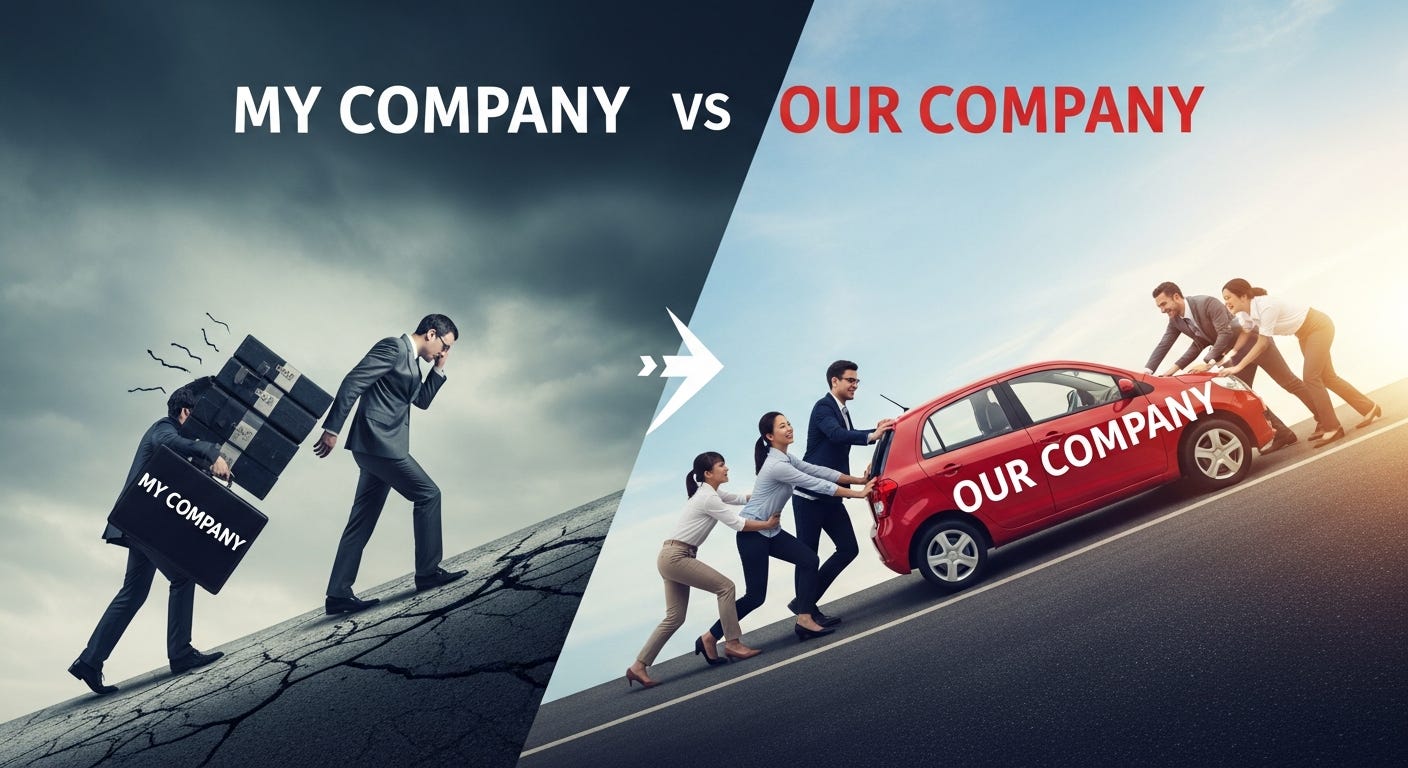
In the business world, a simple choice of words can communicate a lot—your mindset, your ownership structure, your culture, and even your leadership style. Two commonly used phrases—“My Company” and “Our Company”—may look similar but send very different messages.
Whether you are a solopreneur, a founder, or part of a large organization, understanding this difference matters more than you think.
In this blog post, we’ll break it down clearly.
1. What Does “My Company” Really Mean?
When someone says “My Company,” it usually reflects:
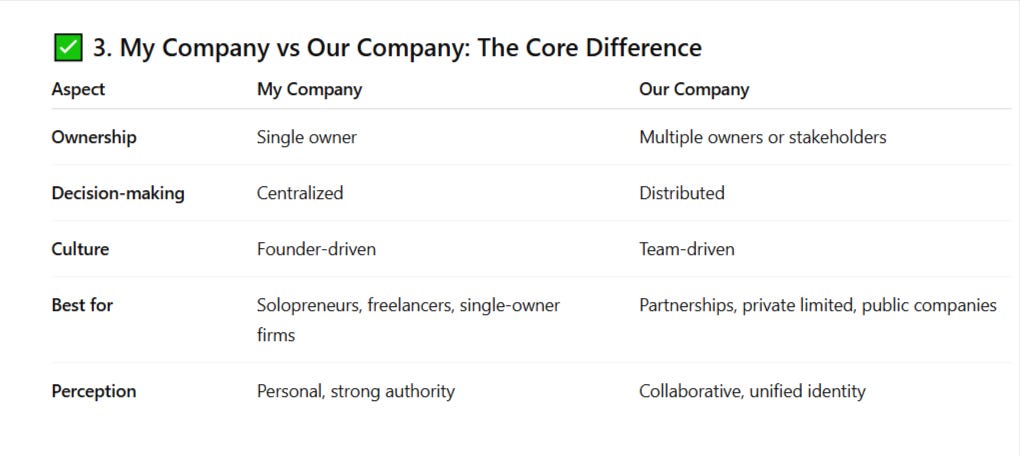
1.1. Complete or Majority Ownership
This term generally applies when:
The business has a single owner, such as a:
One-person company (OPC)
The founder has full control over:
Business decisions
Finances
Operations
Direction of the company
1.2. Founder-Led Impression
“My company” communicates a personal brand around the owner.
It highlights:
Individual leadership
Personal commitment
Direct responsibility
1.3. A Sense of Personal Ownership
Using “my company” builds a personal connection but can sometimes sound:
Authoritative
Individualistic
Less team-oriented
This is perfect for solo entrepreneurs or single-owner businesses.
2. What Does “Our Company” Mean?
The phrase “Our Company” indicates shared ownership or shared responsibility.
2.1. Partnership or Multi-Owner Businesses
Typically used when:
The company is a partnership firm
A private limited company with multiple shareholders
A public limited company
A start-up with co-founders
An organization with decision-making spread across departments or leadership groups
Here, responsibilities and ownership are distributed among more than one person.
2.2. Signals a Team-Oriented Culture
Using “our company” reflects that:
The business is run collectively
Everyone is part of achieving goals
The culture values teamwork
Employees feel more connected when leaders say “our company.”
2.3. Leadership Mindset Shift
Companies with more than one stakeholder adopt a collaborative approach:
Shared decision-making
Mutual responsibility
Joint ownership of results
This builds trust internally and professionalism externally.
4. Why This Difference Matters
You may question, “It’s only one word—why does it matter at all?”
But the words you use shape how people understand your business.
4.1. Builds Your Brand Image
Investors, clients, and employees interpret the difference instantly:
“My company” → Founder-led, small, individual-driven
“Our company” → Structured, team-based, scalable
4.2. Improves Employee Morale
If you have a team, saying “our company” makes employees feel:
Valued
Connected
Responsible
This increases motivation and ownership.
4.3. Shows Professional Maturity
Startups often begin with “my company.”
But as they grow, they naturally shift to “our company”—a sign of:
Growth
Team expansion
Broader leadership
4.4. Impacts Customer Trust
Clients prefer dealing with stable and organized companies.
“Our company” often sounds more reliable and well-structured.
5. Which One Should YOU Use?
Use “My Company” when:
You are the only owner
You take all decisions
You handle operations yourself
Use “Our Company” when:
You have partners, co-founders, or shareholders
You run a private/public limited company
You have a team involved in decision-making
You want to promote team culture
The difference between “My Company” and “Our Company” is more than grammar—it’s about ownership, mindset, and business culture.
“My Company” is perfect for one-person driven businesses.
“Our Company” reflects shared responsibility and collaborative growth.
Choose the phrase that truly represents your business structure and leadership style.